Kyrenia Gate (Nicosia)
📍 Walled city, Nicosia
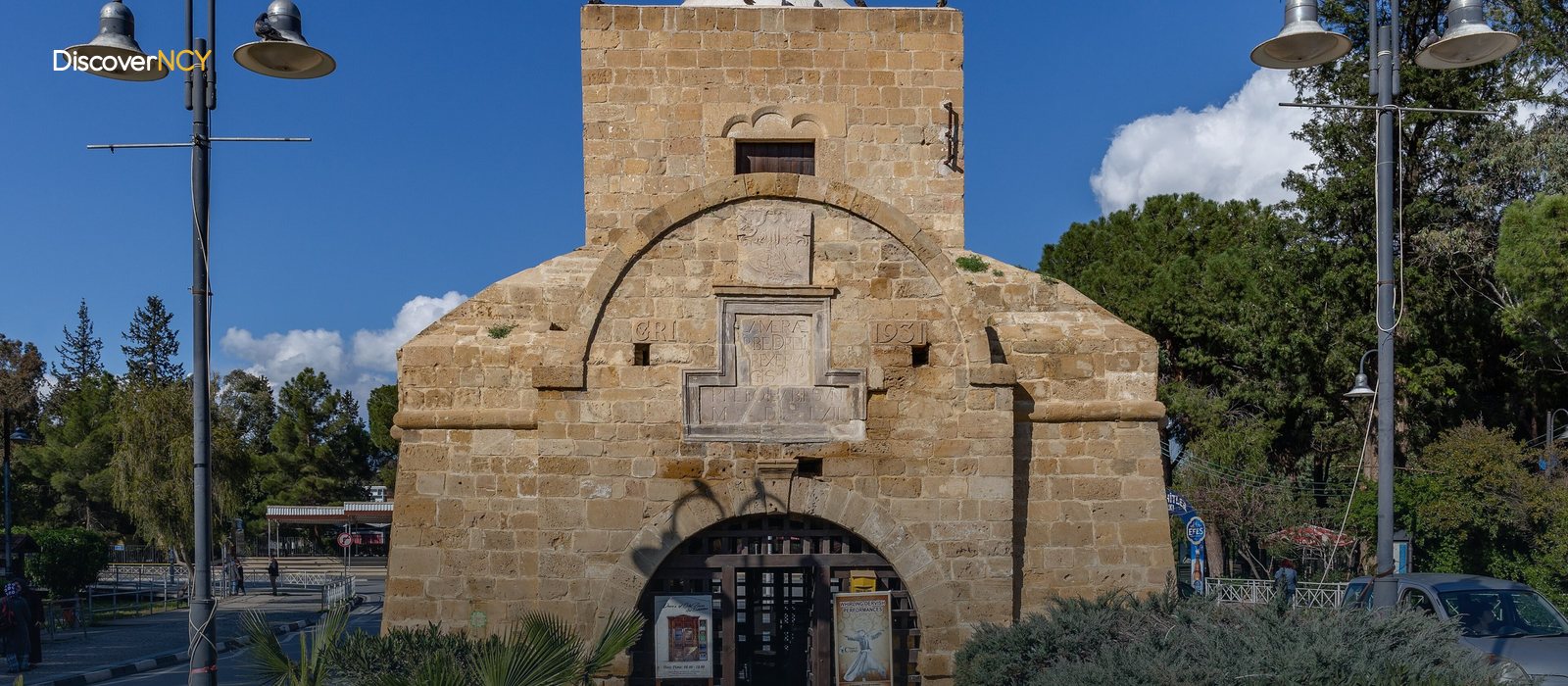
Inside a stone arch built four and a half centuries ago to withstand cannon, city maps are handed out today. The inner rooms of Kyrenia Gate have become a free tourist information office, and nobody passing under the arch is asked for a ticket any more. The building's role has changed several times. Each change left its own mark on the stone: Venice's defensive gate first became the Ottomans' entry point with a guard room, and then the British administration cut through the wall on either side and left it standing in the middle of the road. The dates of the layers can be read in order, and that order is also the explanation for the arch's detached look. Inside the gate, too, hang photographs of the old gatekeeper who is said to have died in 1946 at the age of 121.
A Wall Project Born of the Fear of Malta
The Venetian administration decided to re-fortify Nicosia after the Siege of Malta in 1565, because the island was thought to be the Ottomans' next target. The existing medieval walls were inadequate against artillery, and the plan for the new line, with the pentagonal bastions the age demanded, was entrusted to the chief engineer Giulio Savorgnano. Savorgnano is reported to have arrived on the island on 7 March 1567, and construction began that year. It was never finished. When the Ottoman army under Lala Mustafa Pasha reached the city in the summer of 1570 part of the line was still incomplete, and the city went into the siege with a half-built defence. The siege ended on 9 September 1570. Sources give its length as roughly forty-five days, and the arch you meet today at the northern entrance is one of the three gates of these walls.
Built by Demolishing the Old City
The new line of walls was built on top of the old city, and the medieval walls of the Lusignan period were demolished entirely; of that line's five gates not one stands today. The demolition was not limited to the walls: the Venetians dismantled palaces including the royal palace, houses, Orthodox and Latin churches and monasteries and carried their stones to the new line, and removed the buildings outside the walls because they blocked the field of view. Even the bed of the Pedieos stream was diverted, its water sent into the moat outside the walls; the new line traces a roughly circular perimeter of about 4,800 metres, with eleven pentagonal bastions ranged along it. The bastion names come from Venetian commanders and noble families. The names that match across two sources are Sazlı, Bayraktar, Cephane, Musalla, Zahra and Kaytaz. That much is settled; the number of matching names stands at these six.
One of these names comes with a story. The sources tell how, in the final assault of 1570, the Ottoman standard-bearer climbed the Costanza bastion and planted the flag, was struck down there, and the bastion was later known as "Bayraktar", the standard-bearer. The places where the fighting was heaviest are given in the sources as the "western" and "south-western" bastions (what the northern arch went through that day is unrecorded).
The Names of the Three Gates and the Type of This Arch
Only three monumental gates were left in the wall, and today the only gate you meet when entering Nicosia from the north is Kyrenia Gate. Each had its own Venetian-period name. The northern gate appears in the records as "Porta del Proveditore", meaning the Governor's Gate. The name is traced to the title of Provveditore held by Venice's official on the island; whether the name belonged to a person or to the office is not settled in the sources, while the present name comes from the fact that the road from Nicosia to Kyrenia begins at this gate. A single source reports that in the Ottoman period the building was also called "Edirne Gate". Let us note that we do not treat a name found in a single source as established. The other two gates remained south of the Green Line, and the shape of the arch differs from gate to gate: the northern passage is round-arched and carries a domed lookout room on top.
The 1821 Repair Added a Room on Top
The Ottoman administration had major repairs carried out on the building in 1821, and the domed square room above the arch was added in that repair. The room was a guard post. The reason given is fear of a possible Greek uprising, but this rests on tradition rather than on a document. The real mark the repair left on the stone is two inscriptions. On the marble panel on the north face is a two-line text by a Mevlevi calligrapher; the panel is dated 1236 in the Hijri calendar, corresponding to 1820-1821, and the text opens with verse 13 of Surah As-Saff. How legible the inscription is today is unrecorded. On the south face you can make out the tughra of Mahmud II. The sources differ on the calligrapher's name; the note we have records only a Mevlevi dervish.
In 1931 the Wall on Both Sides Was Cut
After 1878 the British administration opened gaps at various points in the walls, and the northern gate's turn came in 1931. That year the sections of wall and the ramps on either side of the arch were removed, two passages wide enough for motor vehicles were opened, and the building thus ceased to be an entrance attached to the walls and became a free-standing monument left in the middle of the road. The arch standing in the middle of the traffic seems odd at first glance; the wall on either side was dismantled in 1931 for the carriageway. On the south face you can also see the letters "GVRI" from that period (George V Rex et Imperator, that is, King George V) and the date 1931. The 1821 inscription on the north face stayed in place, so the two faces of the same building carry the stamps of two different administrations. It is also related that the building was restored by Nicosia Municipality in 1984 and received an award; in our reading this record is found in a single source.
What Goes On Inside the Arch Today?
The rooms inside the arch are used as the Nicosia Tourism Information Office, and entry is free. Is there an interior to visit? We have no confirmed information on how much of the inside can be seen; visitors do not look for a ticket desk. The office is reported to display photographs belonging to Horoz Ali. There is no timetable either. Our suggestion is to tie your visit to weekday daytime hours. Since the arch stands in the middle of the road its two faces can be viewed from outside, but the photographs are inside; if the office is closed you can still see the facades.
The story of this gatekeeper is the best-known legend associated with the building. The gatekeeper known among the people as Horoz Ali is said to have been appointed here in the Ottoman period, to have refused to hand over the key when the island's administration passed to the British in 1878, and then to have been kept in his post. According to the same account he died in 1946 in the room at the gate, at the age of 121; the story also circulates in local publications under the titles "The Epic of Horoz Ali" and "The Grandchildren of Horoz Ali". There is no birth record, and neither his real name nor the reason for his nickname appears in the records we have. Which part of this story rests on documents? On the history side 1567, 1821 and 1931 are documented, while the gatekeeper's age and the key scene rest on tradition; do not miss this point, the two layers are kept apart.
Where the arch leads into the city lies İnönü Square, and Girne Avenue runs from the gate towards Sarayönü (Atatürk Square); for the traveller arriving from the north the city's main axis begins beyond this opening. About a hundred metres to the south is the Mevlevi Tekke Museum, so it is part of the same walk. If you bear in mind that the inscription on the north face was written by a Mevlevi calligrapher, calling in at the museum after the arch gives the order meaning too. Since restoration continues in stages you may not meet the same scene around it on every visit. As some of the bastions lie on the other side of the Green Line, it is not possible to walk the whole of the walls in a single circuit. Those who build their walled-city tour from the north start by passing under Kyrenia Gate.
| Fact sheet | Detail |
|---|---|
| Original name | "Porta del Proveditore", i.e. "the Governor's Gate" |
| Construction | Work on the walls began in 1567 (Savorgnano plan); the siege came before the wall line was completed |
| Wall dimensions | About 4,800 metres, 11 pentagonal bastions, 3 monumental gates |
| Ottoman repair | 1821, domed room on top, tughra of Mahmud II on the south facade |
| British period | 1931, the walls on either side were cut through, "GVRI" on the south facade |
| Current use | "Nicosia Tourism Information Office" |
| Entry | Free |
A hundred metres on, the Mevlevi Tekke Museum continues the same walk; at the end of Girne Avenue waits the Venetian Column Nicosia page, and for the rest of the walled city see our Nicosia travel guide.