Venetian Column and Sarayönü Square (Nicosia)
📍 Sarayönü (Atatürk) Square, Nicosia
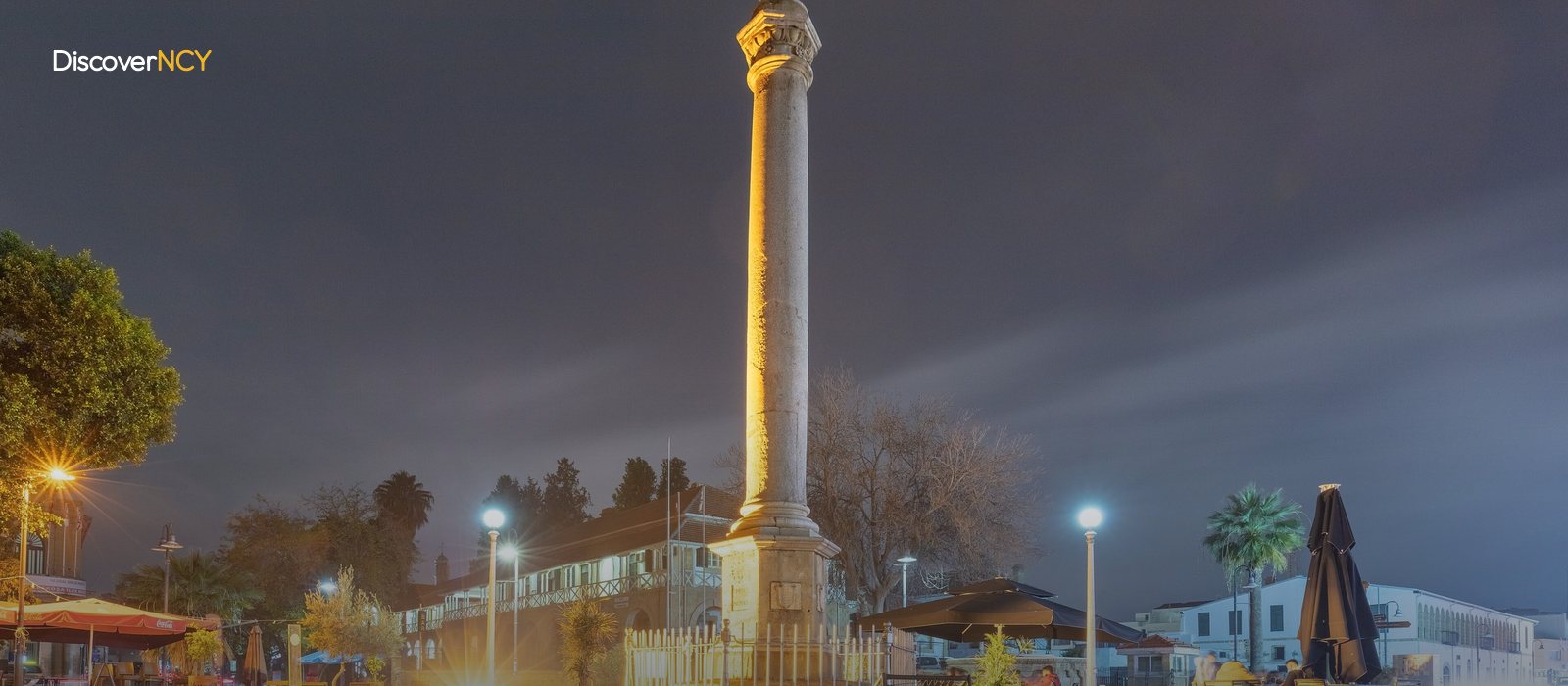
The large stone column in the middle of Nicosia's walled city was carved somewhere else, and this is not the first time it has been erected on its present spot. According to most sources this monument, known as the Venetian Column, came from the ruins of Salamis. It was erected in the Venetian period as a symbol of dominion, dismantled in the Ottoman period and placed near a mosque, and according to the records erected for a second time on its present site in 1915. The Venetian lion on its top did not come back from these moves. What really moved, though, was not the stone but the ground beneath it, because according to the records we examined the square itself changed its name several times over the same centuries. To place the stone, we first need to line up those names. Let's go through the details and the key points.
The Stone from Salamis and Two Erections
The stone's origin is sought at the other end of the island. While it is accepted that the column, carved as a single piece, was brought from the ruins of Salamis near Famagusta, the claim that it was taken from a temple appears in the sources only with the note "thought to be". The Venetians had it erected as the symbol of their rule over the island, and the coats of arms of noble Venetian families can be seen on its base. The base is hexagonal, while the column itself is a single piece of grey granite about six metres tall. Its diameter is given in the sources as roughly 70 cm. Venetian rule on the island lasted from about 1489 to 1571, so the stone was set in place at some date between those two centuries. The year of erection is not certain. Most of the sources at hand give 1550, but since there is no inscription on the stone recording a date, that year remains disputed. When you come to the square, look closely at the base. There is a Latin inscription there, Fides incorrupta non pulchritude non hujus ubertas specetur incolar, and no official translation of this line is to be found in the sources.
As a further note, the column was not left in place in the Ottoman period. It is known to have been taken down and placed around the building known today as Sarayönü Mosque, though the details of its exact position vary from source to source. We found that the stone's return to its present site falls in the British period. According to a record based on the diary of Kemalettin Ali Seyyah, the column was lifted between 8 February and 2 August 1915, set up again in the middle of the square and topped with a globe. One source dates the same work to 1917, but since the entry in the diary is dated, the weight of evidence lies with 1915.
What Happened to the Lion on Top?
When we look at the top of the column today there is no lion; instead there is a globe described as copper or bronze. In the Venetian period the lion of St. Mark was placed there, so the stone at the centre of the town also served as a flag. At some point the lion was removed. So when did that happen, and by whose hand? In the records we searched two separate accounts sit side by side: one group of sources says the work was done in the Ottoman period, while another writes that the lion disappeared in the British period, and there is no document confirming either.
What is certain is the empty space on top. The lion's fate remains an open question, meaning there is no lion left for you to look for in the square. Some sources write that a cannonball was placed first in the lion's stead. Since the globe standing there today was added later, according to the records in 1915, the silhouette you will see in photographs does not belong to the Venetian period.
The Names from Orduönü to Atatürk Square
The square's present name comes at the end of a long sequence. Until the 18th century it was known as Orduönü Square; in the Ottoman period it took the name Sarayönü, and in everyday speech was called simply Saray or Konak; in the early years of the British administration it appears in official records as Government House Square. The name Atatürk Square was given in March 1943, in the time of Nicosia Mayor Dr. Themistoklis Dervis. Sarayönü Square and Atatürk Square are not two different places. They are the names of the same square in two different eras.
The building that gave the name, however, no longer stands. Sarayönü means "in front of the palace", the palace of the Lusignan dynasty, and that palace stood on the site of today's Courthouse building, with the dynasty's coats of arms visible on its entrance gate. The palace was demolished in 1904 on the grounds that it was in ruins. So the square carries the name of a palace that has not been there for more than a century. You may also come across accounts linking the column's second erection in 1915 to this demolition, yet eleven years separate the two events. The Venetian Column was never moved again after its second erection, which means it greeted the square's renaming as Atatürk Square in its present position.
The Buildings Surrounding the Square
The square is the oldest area in the walled city where public buildings cluster. The present structure of Sarayönü Mosque was completed in 1902; on the same site there was a Lusignan-period church, and this church had been converted into a mosque in the Ottoman period. The Courthouse was built between 1900 and 1904, and when the neoclassical building opened it housed units such as the land registry, the post office and the police station. These two buildings mark the centre not of the monument but of an administrative order.
A walk around the area does not end at the square. In the lists we compiled, the Arabahmet quarter and the Mevlevi Tekke, Selimiye and Büyük Han are mentioned as nearby stops. Büyük Hamam (the Great Bath) and the Museum of Stone Works are also counted in the same area. It really is worth not squeezing the square into a narrow hour; you can only work out the order of these stops by seeing them on the spot.
The Square's Real Job Was Always Administration
Nicosia's administrative centre has been this area for centuries. Official business is conducted here, and when the people gather, this is where they have always come. Nor has the function changed. Public meetings and demonstrations are held in this square, and the column stands right in the middle of that crowd. What does someone who only looks at the column and leaves the square miss? Since the stone's meaning was born together with the public buildings around it and the square's changing names, what gets passed by without a glance is really the square itself.
Visiting It as an Open-Air Monument
The first note we will give you is this: there is no such thing as a ticket queue here. Because the monument stands in the middle of an open square, no system of gates and visiting hours applies, and indeed the structure is not registered as a museum or archaeological site. That said, the sources saying it is free and has no time limits are commercial travel websites; there is no official visitor page. The picture we see in the records is this: the square itself, as a public space, can be walked at any hour, while the mosque and public buildings around it operate according to their own schedules.
The column's popular name is Dikilitaş (the Obelisk), and in searches this name can get mixed up with the obelisk in Istanbul, so typing Sarayönü Square directly into the map will save you a needless search detour. In front of the Venetian Column the real task is knowing which name carries which era of the square. The monument's present state of upkeep is something you can see on the spot rather than in the sources. Knowing that a lion once stood beneath the globe on top is the detail that gathers the sequence of names from Orduönü to Atatürk Square at a single point.
| Field | Value |
|---|---|
| Place | Nicosia walled city, centre of Sarayönü (Atatürk) Square |
| Popular name | The Venetian Column, Dikilitaş (the Obelisk) |
| Material | Single piece of grey granite |
| Origin | The ruins of Salamis, with sources noting "believed to be" |
| Height | About 6 metres; sources give between 6 and 7 metres |
| Base | Coats of arms of noble Venetian families, Latin inscription |
| Top | Copper or bronze globe; the lion of St. Mark is gone, its fate unknown |
| Entry | Open air, no ticket office or gate |
| Category | Not a museum or archaeological site, an open-air monument |
To extend the route see our articles on Selimiye Mosque and Buyuk Hamam, both within walking distance of the square, and for the overall layout of the walled city our Nicosia travel guide.