Apostolos Andreas Monastery (Karpaz)
📍 Dipkarpaz (Rizokarpaso), Karpaz Peninsula
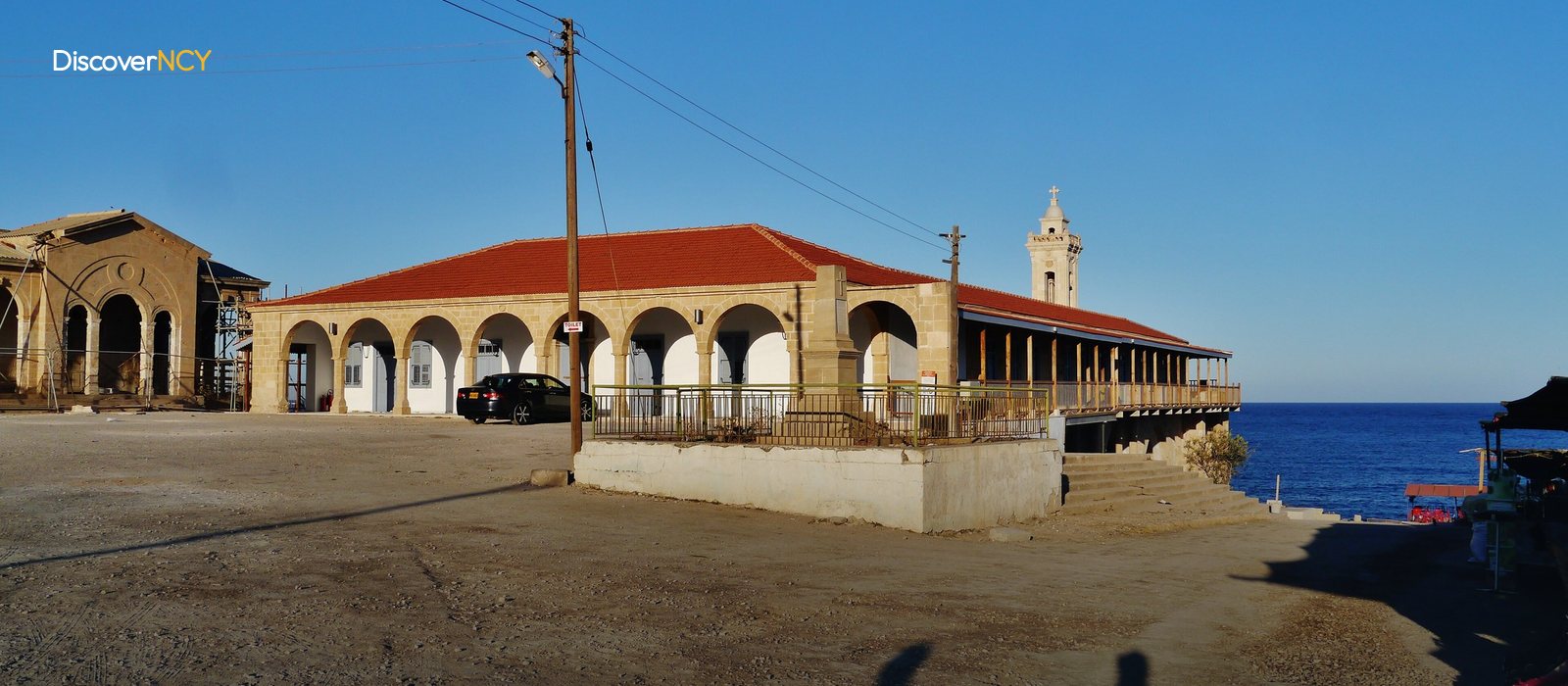
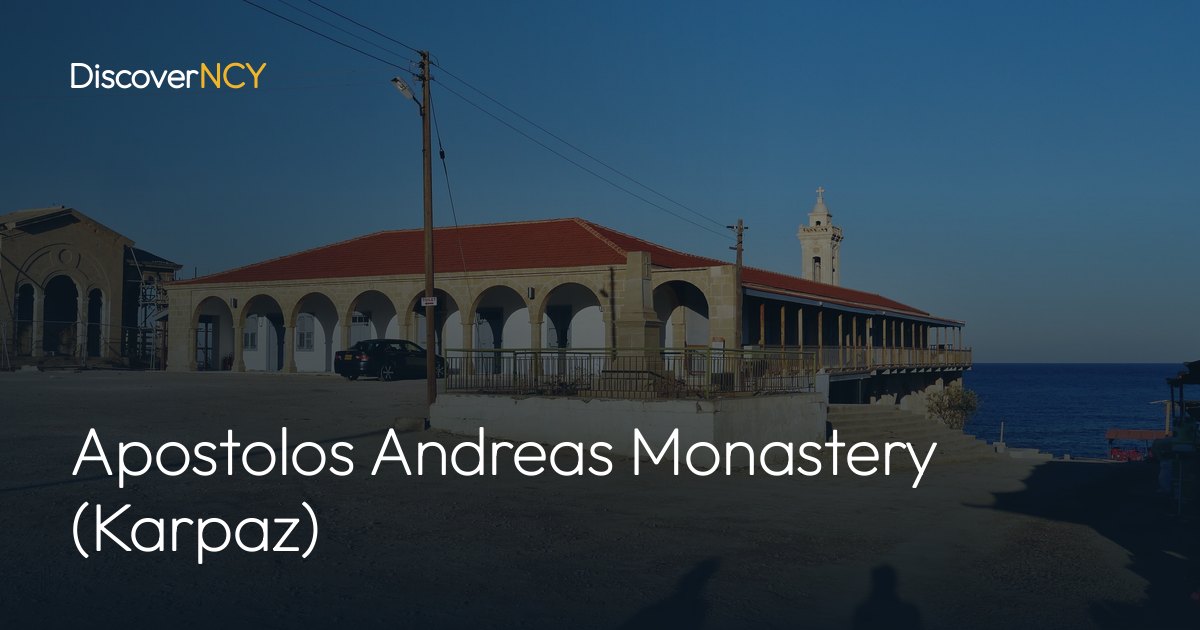
In the Karpaz the asphalt runs out a few kilometres short of Cape Apostolos Andreas (Zafer Burnu), and Apostolos Andreas Monastery stands on these last metres of the road. Where the surface ends, you will see a cluster of stone buildings appear on your right, looking out to sea. Two separate lives go on in the courtyard: on one side there is a living place of worship where services are held, and on the other a restoration site that has not closed in years, and it is the second that decides how much of the courtyard you can walk around on a given day. Those who build their Karpaz route around this place usually get it right, because the road out to the monastery takes your whole day.
A Monastery Where the Road Ends
The monastery is at the easternmost tip of the Karpaz Peninsula, just south of Cape Apostolos Andreas (Zafer Burnu); to reach it you take the Karpaz main road out of Dipkarpaz (Rizokarpaso) and head north-east for about fifteen kilometres. Golden Beach (Altınkum) falls behind you, and the building can be seen on the right. Locally the building is also known as Ayandreya Monastery. Over these last fifteen kilometres the houses thin out, the signposts grow scarce and you may see wild donkeys grazing by the roadside. This stretch is asphalt. The road that continues from the monastery to the cape, however, is dirt and, as far as we could establish from online sources, genuinely rough. The two routes are often confused, yet they are not the same road: one takes you to the monastery, the other to the tip of the cape, and if you set out without knowing the difference you will wear out your car for nothing. Public transport does not reach the area, so access is by private car only, which means the plan is built around a car from the start. If you are looking for a stop to pass off with a half-hour break, this is not for you. It is the final link in a Karpaz trip that spreads across a full day.
Three Layers from the 15th to the 19th Century
The standing building is not the work of a single period, and its beginning is thought to rest not on a document but on a legend. According to belief, the Apostle Andrew came ashore on his way to the Holy Land because his ship had run out of water, and struck the rock with his staff; the ship's captain washed his blind eye in the water that gushed out and so regained his sight. Recorded history begins later. In the 15th century a small chapel was built over that spring, and the core of the monastery was formed that way. The spring still flows today. The small chapel near the shore stands directly over the point where the water emerges.
The main church, as we found in the historical sources, rose in the 18th century, and the parts that give it its present exterior were completed in the 19th; the architecture shows the influence of both the Byzantine and the Ottoman periods. That is also why the building does not look as if it came from a single hand. There are sources that speak of a far older monastery in the area going back to the 12th century, but the main chronology still begins in the 15th. The Apostle Andrew is known in Christian tradition as the First-Called. The monastery is dedicated to this apostle, and takes its name from him.
Restoration Has Been Under Way Since 2013
The restoration committee, on which both communities are represented, was set up in 2008, and the comprehensive work, according to the sources we consulted, began in 2013. The funding was shared between the institutions of the two communities and international organisations. Even so, the project is still not closed. As of March 2026 the work continues; the UN Development Programme and a Cyprus-specific Technical Committee on Cultural Heritage are also involved in the process, and it is these bodies that report the work is progressing according to the timetable and technical requirements. Why have thirteen years not been enough? The presence of representatives from both communities on the committee and the involvement of international organisations partly explain it, as does the way salt and wind speed up the wear on a stone building this close to the sea. When the two factors combine, the timetable can stretch.
When you arrive at Apostolos Andreas Monastery you will find the concrete result of this, because in some areas you may see scaffolding, sheeting or a section temporarily closed off. Is it possible to find out in advance which part will be closed on a given day? No; no institution announces this in any form. You can only notice the closed part on the spot, and there is a chance of going home without having walked the whole courtyard; if you factor that in from the start, you will not be surprised to meet an incomplete courtyard at the end of the road.
The Two Busiest Days of the Year
The monastery belongs to the Church of Cyprus and regular services are held inside; the two busiest days in the calendar are 15 August and 30 November, the first coinciding with the Dormition of the Virgin Mary and the second with St Andrew's Day. On those two dates the courtyard fills beyond recognition. The visitor profile is not limited to a single faith, because the building is held in respect by both Christians and Muslims. There is no formal dress check at the entrance. Covered shoulders and knees are still expected, because this is not a museum but a working place of worship. Those who want to catch a service look for these two dates; those who want a quiet courtyard set their calendar for another day.
Two More Stops on the Way Back
Having come this far, planning the monastery on its own is, in our view, a bit of a stretch. Golden Beach (Altınkum) lies ten to fifteen minutes behind you, Cape Apostolos Andreas (Zafer Burnu) at the island's easternmost tip is a few kilometres to the north, and the building sits right between the two; so our suggestion is that gathering all three into a single trip will not be hard. Two more stops also wait in the direction of Dipkarpaz (Rizokarpaso). The Church of Ayios Philon dates from the Byzantine period, while Aphendrika is an ancient site where the ruins of three churches stand side by side, though you need to allow for the poor state of the road there, because the dirt surface starts again on that stretch.
Getting There and How Long It Takes
If you set out from Kyrenia or Nicosia the total journey is in the two to two-and-a-half-hour band; coming from Famagusta puts you closer to the lower end of that band, and this calculation covers one way only. On this road you reckon in time, not kilometres. Close your shopping list before you set out, because after Dipkarpaz (Rizokarpaso) both settlements and services thin out. No official body publishes visiting hours; in practice it is a place visited in daylight, and it is worth confirming the current situation before leaving. In the summer months shade and facilities can be limited, so taking water in the car is no empty piece of advice. More than a hundred reviews have accumulated on Tripadvisor, and the number of uploaded photos exceeds that.
Starting the day early pays off in two separate ways. The first is the heat: the most scorching part of midday stays off your route. The second, and the more important, is the return, because getting from Apostolos Andreas Monastery back to Kyrenia takes another two and a half hours, and driving this road in the evening dark is tiring.
| Field | Value |
|---|---|
| Name | Apostolos Andreas Monastery (Ayandreya Monastery) |
| Location | Easternmost tip of the Karpaz Peninsula, just south of Cape Apostolos Andreas (Zafer Burnu), Iskele district |
| Getting there | ~15 km north-east of Dipkarpaz (Rizokarpaso), 2-2.5 hours from Kyrenia/Nicosia, private vehicle only |
| Founded | Small chapel at the spring site in the 15th century |
| Main building | Church 18th century, present exterior 19th century |
| Legend | Holy water that sprang from the spot the Apostle Andrew struck with his staff |
| Status | Belongs to the Orthodox Church of Cyprus, active place of worship |
| Busiest days | 15 August, 30 November |
| Restoration | Committee 2008, work began 2013, still ongoing as of March 2026 (UNDP + Technical Committee on Cultural Heritage) |
| Opening hours | No official hours announced, visit in daylight |
| Dress code | Shoulders and knees covered |
| Nearby stops | Golden Beach, Cape Apostolos Andreas (Zafer Burnu), Ayios Philon, Aphendrika |
| Tripadvisor | Over a hundred reviews |
| Road conditions | Asphalt up to the monastery, dirt track beyond |
For the rest of the peninsula see our Karpaz Peninsula guide, for the last village before the monastery the Dipkarpaz village page, and for the organised alternative to driving yourself the Karpaz safari tour guide.