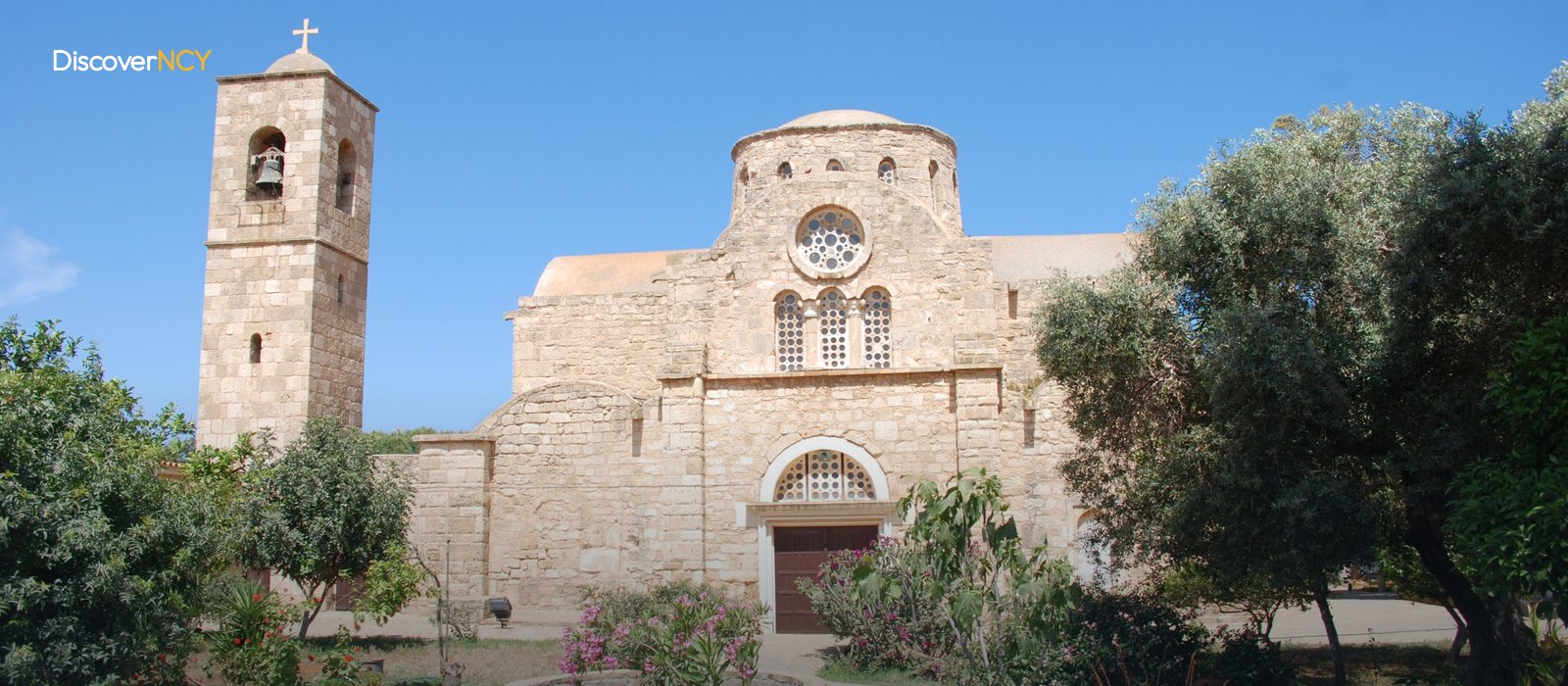
St. Barnabas Monastery and Icon Museum
📍 Between Tuzla village and the Salamis ruins, Famagusta
Today we take a closer look at St. Barnabas Monastery... The most talked-about part of this monastery sits inside the building where the tickets are sold... The tomb chapel stands about 300 metres west of the main complex as a separate small mausoleum, and the actual burial chamber is reached from there by 14 steps down. A good share of visitors tour the two museums, go back to the bus and never see those steps. Yet the monastery's entire founding story begins precisely in that low-ceilinged chamber. According to the sources we reviewed, this is a complex a few kilometres north of Famagusta, right beside Salamis, housing two separate museums around a single courtyard, so you need to decide at the gate how much time to give each section.
Two museums, one courtyard
Set between the village of Tuzla and the ruins of Salamis, St. Barnabas Monastery today houses two separate museums under a single name. The church section has been arranged as the Icon Museum and is known to hold a rich collection dating from the 18th century. And if your curiosity runs to the contemplative side of history, the old monks' cells and the arcaded wing are given over to the Archaeological Museum, where the display cases hold finds from Salamis and its surroundings going back as far as the Neolithic period. So you walk in through one door and wander between two entirely different eras: painted wood in one, pottery and stone in the other.
This duality also splits the pace of the visit. No religious community remained at the monastery after 1974, so there is no monastic life here and the building is run entirely as a museum. On the icon side people tend to slow down, because the surface to look at is small and dense. In the archaeology wing the row of cases runs out quickly. Positioned as a half-day stop, this courtyard counts as half-unseen if it is rushed.
Why is the chapel 300 metres away?
Plenty of people have asked this question among themselves, even online, and it is a fair one, because in monasteries the tomb is usually inside the church or right next to it. Here the arrangement is reversed. The small chapel built in the 19th century marks the traditional burial site of Barnabas, and the spot it marks lies outside the church's boundaries, within the Salamis necropolis. The burial ground spreads over a wide tract of land from Enkomi to the monastery, so the free-standing chapel is in fact standing in its own neighbourhood.
The chamber beneath the chapel is low, like a cave. You go down 14 steps and a stone sarcophagus stands at the bottom. The descent is narrow and the ceiling is low, so this section is not considered suitable for a visitor with limited mobility. The main museum side stays on level ground and poses no such difficulty, and there is no significant change in level between the church and the cells either. It is worth not putting the two sections on the same difficulty scale, because someone who strolls the courtyard comfortably may struggle at the foot of the steps.
The story from a dream to autocephaly
The narrative goes back to the late 5th century. Anthemios, Archbishop of Salamis, sees the location of the tomb in a dream; a search is made, and from a grave beneath a carob tree a body is brought out with a copy of the Gospel of Matthew laid on its chest. Anthemios takes the relics to Emperor Zeno, and that discovery is held to be the basis for the Church of Cyprus's independence from the Patriarchate of Antioch, in other words its autocephaly.
Around AD 477 Zeno had a timber-roofed basilica built right beside the tomb. Cells, a garden, an aqueduct and pilgrim guesthouses were added around it, and in the reign of Justinian I Archbishop Philoxenos had two more buildings put up. In short, the courtyard you tour today was built on a discovery that determined the legal status of a church, and the sole witness to that discovery is the account of a dream. A dream seen by one cleric becoming the foundation of an entire church's independence is, without doubt, a rare outcome in history.
The 1756 restoration shaped today's building
The domed, cross-in-square building you see in the courtyard is not Zeno's basilica. The original Byzantine church was badly damaged in the Arab raids of the 7th century, and what survives from that period is essentially the apse on the eastern side. Today's form comes largely from the restoration commissioned by Archbishop Philotheos in 1756.
Telling the layers apart from outside is not easy, because the stone is the same stone and the walls look as if they came from a single hand. Still, anyone who looks carefully at the apse side will notice thirteen hundred years of continuity meeting eighteenth-century workmanship in the same wall. The same goes for the dome: the silhouette you see when you look up is the legacy of an Ottoman-era repair decision.
The gate closes at 18.00
According to the summer schedule of the Department of Antiquities and Museums, as of September 2026 St. Barnabas Monastery is open to visitors between 08.00 and 18.00, with last entry at 17.00. Winter hours were unclear at the time this article was prepared, so anyone setting out after October would do well to check the latest announcement.
The museum charges admission. There is a separate student rate, and TRNC citizens are admitted free on Sundays. In 2026 there is scaffolding on the exterior and renovation work is under way, but the building is not closed to visitors. Anyone who spots the scaffolding from a distance and turns back at the gate has turned back for nothing, because everything inside runs as normal.
The nearby stops fit into the same day
The monastery stands about two kilometres west of the Salamis ruins, but the two are separate places. The theatre and the Gymnasium of Salamis spread over another area, which is visited as a separate archaeological site. The Royal Tombs and Enkomi are very close, and the walled city of Famagusta (Suriçi) fits into the same day too.
The road from Ercan Airport to Famagusta is about 50-52 kilometres and takes 40-50 minutes by car; the last few kilometres to the site come on top of that. Since it lies just north of the city, someone who spends the morning in the walled city can comfortably use the afternoon here. Tour buses usually put it on the same day as Salamis, so the courtyard can get crowded around midday.
So is it possible to go down into the crypt and tour both collections in half a day? The distances and the closing time allow it, provided you factor in the stepped descent and the different pace of the two museums. The figures you need to keep in hand when planning your day at St. Barnabas Monastery are in the fact sheet below.
| Field | Value |
|---|---|
| Name | St. Barnabas Monastery and Icon Museum |
| Location | Between the village of Tuzla and the Salamis ruins, a few km north of Famagusta |
| Distance from Ercan | About 50-52 km via Famagusta, 40-50 min by car |
| Founded | Around AD 477, financed by Emperor Zeno |
| Current building | Largely the 1756 restoration, Archbishop Philotheos |
| Museum layout | Church = Icon Museum, old cells = Archaeological Museum |
| Tomb chapel | ~300 m west of the main building, 19th-century structure, crypt with 14 steps beneath it |
| Opening hours (summer 2026) | 08.00-18.00, last entry 17.00 |
| Opening hours (winter) | Not announced separately, check the latest notice |
| Admission | Charged, student discount available |
| Physical difficulty | Crypt has steps and a low ceiling, main museum on level ground |
| Nearby stops | Salamis (~2 km), Royal Tombs, Enkomi, the walled city of Famagusta |
| Managed by | TRNC Department of Antiquities and Museums |
| Status in 2026 | Exterior renovation and scaffolding, open to visitors |
For the ruins next door, see our Salamis ancient city page; for the rest of the city, the Famagusta travel guide; and for the island's other castles and monasteries, our list of historic sites of North Cyprus.