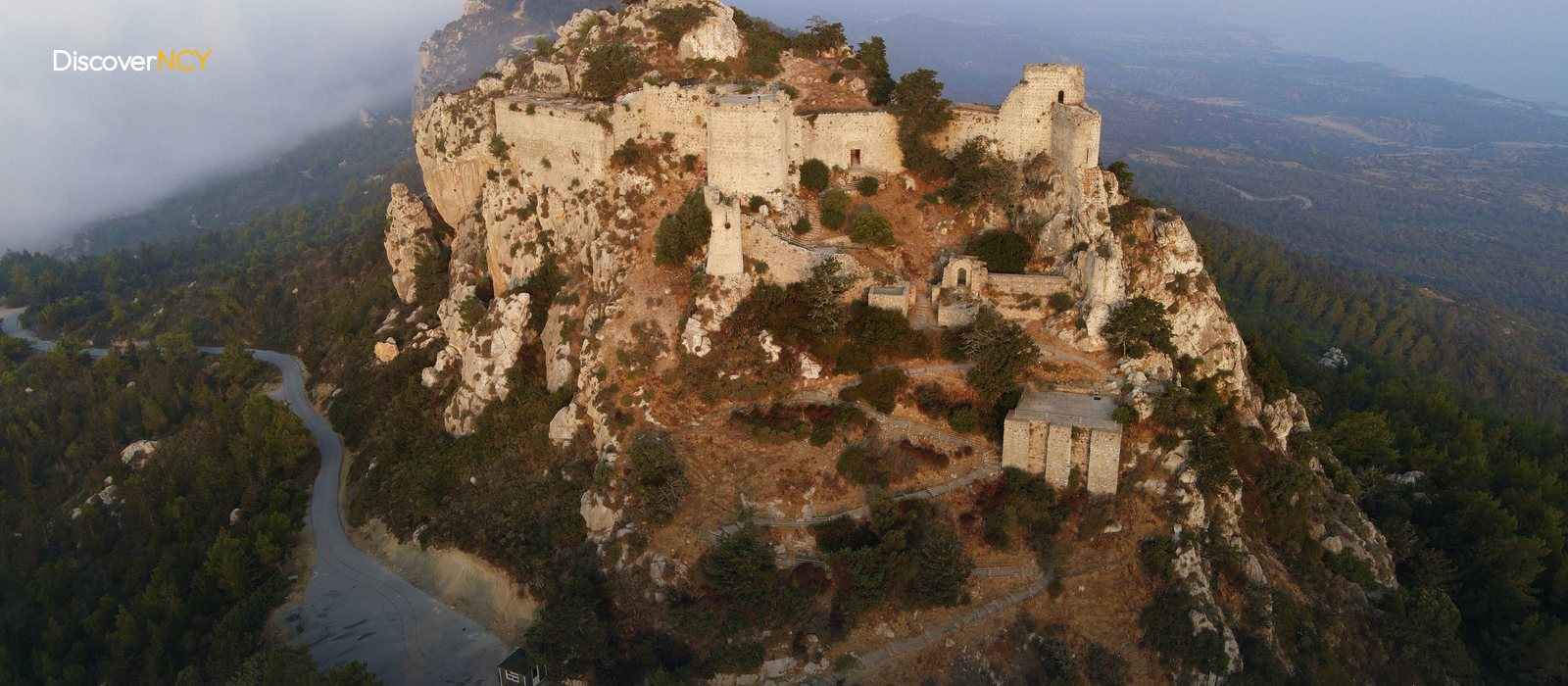
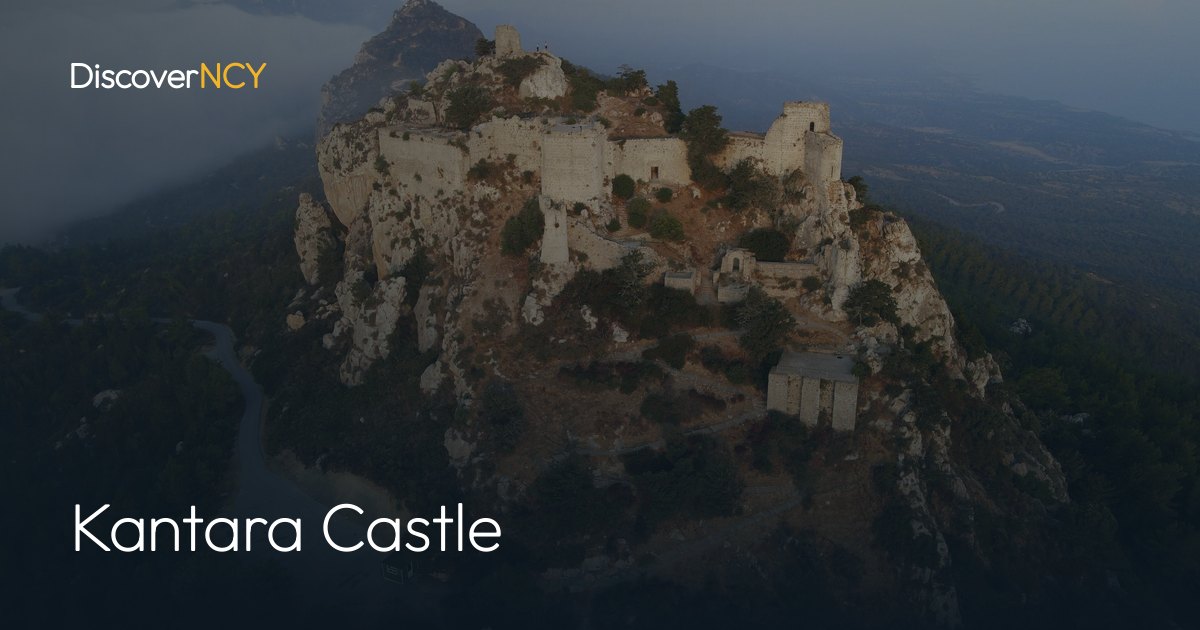
Kantara Castle
📍 Above Kaplıca village, eastern end of the Kyrenia Mountains, Iskele
Most drivers heading north from Famagusta pass the "Kaplıca" sign without noticing the turn-off they are looking for. The sign is small, and the castle itself only comes into view over the last few kilometres. Kantara Castle takes its name from the Arabic word kantara, meaning bridge, and that name sums up in a single word its job of holding the pass between the plain and the north coast. After the turn-off the asphalt narrows, ends after a few minutes of climbing, and then a line of walls appears on top of the rock. In the sources we reviewed, what really challenges visitors is the narrow time window, because the site is open on weekdays only.
Turning off the Karpaz road
Of the three mountain castles this is the easiest to reach by car, and you feel the difference before you even get to the gate. It is roughly 69 kilometres from Kyrenia, 44 from Famagusta and 87 from Nicosia, while for those setting out from the Iskele side the drive is over in thirty to forty minutes. Parking is free and sits close to the entrance, so the car does most of the walking for you. During the drive the sea shifts from your right to your left and the hills drop away, until finally a single mass of rock fills the horizon. This easy access makes it possible to squeeze the castle in at the start or end of a Karpaz tour, as long as the hours work out.
Don't expect crowds. Because the turn-off is not on the tour-bus route, on most days there are only a handful of cars in the car park, and at the top you find a quiet site rather than a queue. You pay for that at the gate, because there isn't always someone on hand to give you information. Junction signs thin out on the last stretch of road, so it is worth opening the map on your phone before the turn-off.
Steep steps from the car park to the gate
The car drops you off; the rest is steps. From the car park to the castle entrance there is a climb of ten to fifteen minutes. Bear in mind that a short climb does not mean an easy one, because the gradient is steep and the steps are uneven. The same warning is repeated in visitor reviews: the walk is not long, but it is not recommended for the elderly or for those with heart conditions. So how hard is it for the average visitor? Someone who walks regularly won't struggle much, while someone who sits at a desk all day may end up out of breath. As with the other castles, our research found no official source that states the "number of steps", so instead of a figure, plan on the climb taking between ten and fifteen minutes.
A military layout inside the walls
Once through the gate, the castle does not stand as a single building but opens out as a layout spread across the slope. Defensive positions, soldiers' quarters, water cisterns, vaulted rooms and watchtowers are still legible, and their positions relative to one another explain how the castle worked. The cistern is no decoration here, because how long a besieged hilltop can hold out is decided by its water. There is no record giving the number of towers and rooms, so rather than trying to count them as you go, noticing which side faces the cliff tells you more. Three sides of the castle are ringed by deep precipices, and the wall built by human hands is really the smaller part of the job.
The colour and coursing of the stone give away how time has layered here, because repaired sections and original wall stand side by side on the same plane. The distinction is not easy to make at first glance; you need to stop and look for a moment. It is those rooms above all that remind you that you are looking at a military installation, since what stands out here is not ornament but the routine of shelter and guard duty.
Two seas seen from the summit
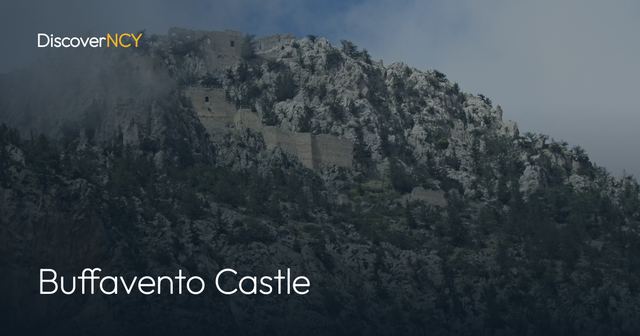
Once you reach the summit, it becomes obvious why this narrow hilltop was chosen. The "Mesaoria Plain" opens on one side and the north coast on the other, and in clear weather both are visible at once. The entrance to the Karpaz Peninsula is watched from here too, so the logic of the location needs no debate. There is a recurring view in travel-site reviews: for many visitors this is the most scenic of the three castles, though that is no official ranking, just the common tendency of the comments. The same line once did real work, because St. Hilarion in the west, Buffavento in the middle and Kantara Castle in the east formed a chain of signal points within sight of one another. Today the view is a photo stop, but when that chain was set up it was the fastest way to pass news from hilltop to hilltop.
Layers from 965 to 1914
The exact date of construction is unknown. Most sources say it was built by the Byzantines after 965, when the Arab raids ended, while the first documented record appears only in 1191. That year Isaac Komnenos, who had declared himself King of Cyprus, took refuge here during Richard the Lionheart's campaign, and once Kyrenia Castle fell he abandoned the castle and surrendered. During the Genoese invasion of 1373, John, Prince of Antioch, held hostage in Famagusta, is said to have escaped with the help of a servant disguised as a cook and reached here within hours; the castle remained under Cypriot control in that period. King James I strengthened the walls in 1391, then in the Venetian period the castle lost its importance and by the 16th century it was in ruins. The last major intervention keeping the layout you see today on its feet is the 1914 restoration.
The matter of opening hours before you go
According to online sources, as of "September 2026" the gate opens at 10.00 on weekdays and closes at 15.30, with last entry at 14.45; it is closed at weekends and on public holidays. Bear in mind that these hours may change. There is an entrance fee, but since the official tariff does not announce a fixed figure, it is worth confirming the current price at the ticket office or via eemd.gov.ct.tr. Müzekart (Turkey's museum pass) is not accepted here; archaeological sites in the TRNC are ticketed separately. Put these three points together and Kantara Castle settles into the middle of your day, because the gate shuts at half past three in the afternoon and latecomers are not let in. Kaplıca is the nearest village, and those continuing towards Karpaz can add Boğaz, Bafra and Yenierenköy to the same route.
| Field | Value |
|---|---|
| Name | Kantara Castle |
| Origin of the name | Arabic "kantara", bridge |
| Location | Eastern end of the Kyrenia Mountains (Pentadaktylos), Iskele |
| Founded | Probably Byzantine, after 965; first documented record 1191 |
| 1191 | Isaac Komnenos takes refuge, Richard's campaign |
| 1373 | John, Prince of Antioch, escapes to the castle |
| 1391 | James I strengthens the walls |
| Venetian period | Loses its importance, in ruins by the 16th century |
| 1914 | Restored and strengthened |
| Access | Free parking, the easiest mountain castle to reach by car |
| Distances | Kyrenia 69 km, Famagusta 44 km, Nicosia 87 km, Iskele 30-40 min |
| Walk | 10-15 min from the car park, steep with steps |
| Hours | Weekdays 10.00-15.30, last entry 14.45, closed at weekends |
| Fee | Paid entry, current tariff confirmed at the ticket office |
For a comparison of all three, see our North Cyprus castles guide; for the hilltop in the middle of the signal chain, our Buffavento Castle page; and for a route you can add to the same day, our Karpaz Peninsula guide.