Vouni Palace
📍 Bademliköy, Lefka
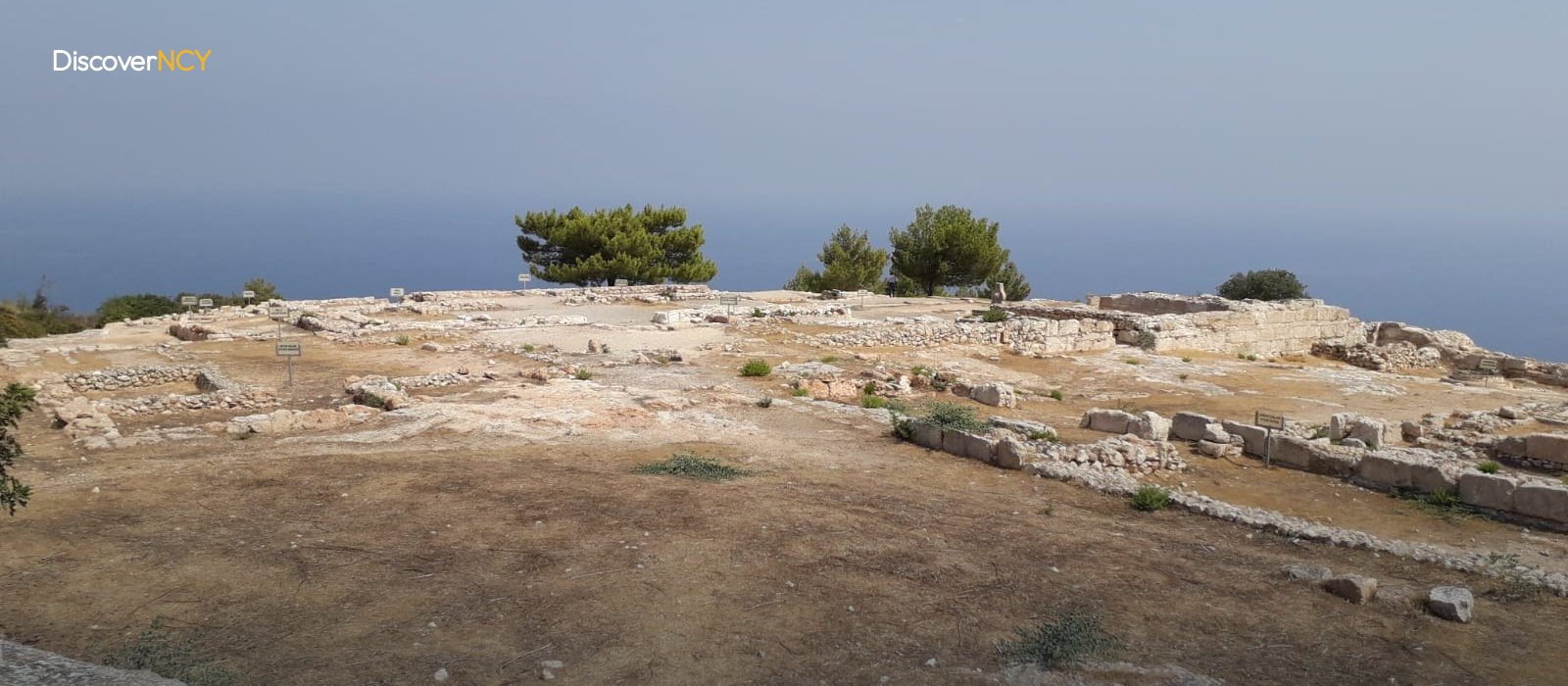
City founders look for places near water. The founders of Vouni Palace chose the opposite and climbed a hill from which they could watch the coast from above. The hill commands the sea. It stands at roughly 250 metres, and the reason for that height was not the view. Below, close to the shore, lies Soli, a city that grew on trade. The ruin today stands near Bademliköy, some 9 kilometres west of Gemikonağı (Karavostasi), and it was built to keep watch over that city. The question most travellers to the area have is whether the two can be squeezed into the same day; the few kilometres between them are the easy part, because the two sites did entirely different jobs: one was a living city below, the other a watch-post standing above. Since they are two ends of the same story, the ruin on the hill makes far more sense when the two are seen together.
Can It Be Done in the Same Day as Soli?
Yes, because the distance is short and the road follows the coast; Soli, moreover, is a few kilometres to the east, right beside the coastal road. Geography is not the only thing linking the two sites: the excavation calendars overlap too, since the Swedish Cyprus Expedition was working at the palace on the hill between 1927 and 1931 when it began digging the city below in 1929. What you see at both sites today is the product of the same team working in the same period.
The useful criterion when deciding the order is shade. On the hill there is less of it than average. On top of that, since the structure descends towards the sea in terraces, you are constantly climbing up and down inside the site, and for someone visiting both ruins in one day that can make a real difference in fatigue. The practical conclusion from what we have looked at is this: leaving the hill for the cool end of the day makes the walk noticeably easier. The visitor route runs along the terraces, and the visitor who enjoys reading a floor plan gets their reward.
A Surveillance Decision Taken Around 500 BC
The palace is dated to around 500 BC, the start of the 5th century, and the kingdom that built it was the pro-Persian Marion. The king, named in the sources as Doxandros, did not pick this hill for the view on a whim: the aim was to watch and keep pressure on the pro-Greek neighbouring city of Soli. Marion and Soli were two separate political camps facing each other on the same island, and the hill measured the distance between those camps at a single glance. What can you see from the hill today? Both the plain and the coastal strip can be made out from the same spot, including the flat ground where Soli stood.
That calculation is reflected in the stone too. In the building's first phase the traces of Eastern architecture, meaning Persian influence, are clear, but as Athens grew stronger in the region Greek elements entered the plan, and to the south of the palace stands the ruin of a Temple of Athena dated to the end of the 5th century BC. Because the rivalry between Persia and Athens was played out in Cyprus through its kingdoms, this building is a document of that rivalry turned to stone. Which side the building faced can be read from the stone itself.
A Terraced Plan with 137 Rooms
The figure surprises when you first hear it: we are talking about a building with 137 rooms. The rooms do not stand as a single block; they are spread over layers that descend in terraces towards the sea. The plan includes entrances, royal apartments, colonnaded courtyards, a kitchen courtyard, cisterns, storerooms, bathing sections and workshops; the Vouni Baths, moreover, count among the oldest examples of the hot-bath type on the island. The cisterns are the most concrete detail showing how the water problem on the hilltop was solved. Water was not carried up; it was collected on the hill. The fact that the kitchen courtyard and the workshops sit in the same plan also tells you that daily life went on here, because a spot used only for standing guard would need neither a kitchen courtyard nor a workshop. A fully functioning palace lived here.
The best-known find from the Vouni Palace excavations came out of this plan too. Inside vessels blackened by fire were gold and silver bracelets, engraved silver bowls and coins minted in Marion, Kition, Lapithos and Paphos; the group came to be known as the Vouni Treasure. The money of four different cities shared the same vessels. That mix suggests this was a centre with regional connections rather than a closed garrison.
The Fire, Around 380 BC
The palace was burned around 380 BC, never repaired and abandoned. Who started the fire? Since the sources do not agree on a single name the culprit remains unknown, but the fire itself and its outcome are certain: the building was never raised again. The excavation team read the trace of that fire in the blackened vessels, and the treasure came out of precisely those vessels.
Between the date it was founded and the date it was abandoned lie some hundred and twenty years, and for a palace that is undoubtedly a short life. That is the measure to keep in mind as you walk around. What you see here is not the slow fading of a city but a decision cut off suddenly.
Directions and Opening Hours
Looking down from the hill you can see a small rocky outcrop on the shore. On this islet, called Petra tou Limniti, traces of settlement going back to the Neolithic period were found (it does not count as part of the palace). It is a far older layer of the region, and since it lies on the same route it can be added as a separate stop. The Soli ruins, the abandoned mining pier at Gemikonağı (Karavostasi) and the centre of Lefka (Lefke) fit comfortably into the same day as well.
In official records the site falls within the Morphou (Guzelyurt) district, so when looking for directions it helps to use the names Lefka (Lefke) and Bademliköy together. The distance from Ercan Airport to the area is given in sources as 77 to 79 kilometres, roughly 1 hour 15-20 minutes by car. For those setting out from Kyrenia or Nicosia the journey is around 1 hour 10-15 minutes. The airport to Nicosia is about 31 kilometres, while Nicosia to Lefka (Lefke) alone reaches 60 kilometres, so most of the drive begins after the capital.
As of September 2026 the Department of Antiquities and Museums lists the summer schedule as 08:00-18:00, with last entry at 17:00. Since these hours can change within the season, it is a good idea to check the current schedule before setting out. There is an entrance fee. Does a single ticket cover both sites? It does not; each site is ticketed separately. Tickets are bought at the gate, and under the regulations free entry is granted only to certain groups, among them children under 12 and TRNC citizens aged 65 and over.
Vouni Palace is the surviving floor of a political decision written onto a hilltop.
| Field | Value |
|---|---|
| Name | Vouni Palace |
| Region | Morphou (Guzelyurt) district, near Lefka (Lefke)/Bademliköy |
| Period | Built around 500 BC, abandoned around 380 BC |
| Built by | The pro-Persian Kingdom of Marion |
| Purpose | To keep watch over the pro-Greek city of Soli |
| Elevation | About 250 m, on a hilltop overlooking the sea |
| Number of rooms | 137 |
| Key find | The Vouni Treasure (gold and silver jewellery, coins) |
| Excavation period | 1927-1931, Swedish Cyprus Expedition |
| Opening hours (summer) | 08.00-18.00, last entry 17.00 |
| Admission | Paid, tickets at the gate |
| Distance from Ercan | ~77-79 km, ~1 h 15-20 min |
| Distance from Kyrenia/Nicosia | ~1 h 10-15 min |
| Nearby stops | Soli ruins, Petra tou Limniti, Gemikonağı (Karavostasi) pier, Lefka town centre |
To see the city the hill was built to watch, read our Soli ruins page; for the other stops in the area see the Guzelyurt and Lefke guide, and for the island's castles and ancient cities as a whole, the historic sites of North Cyprus guide.