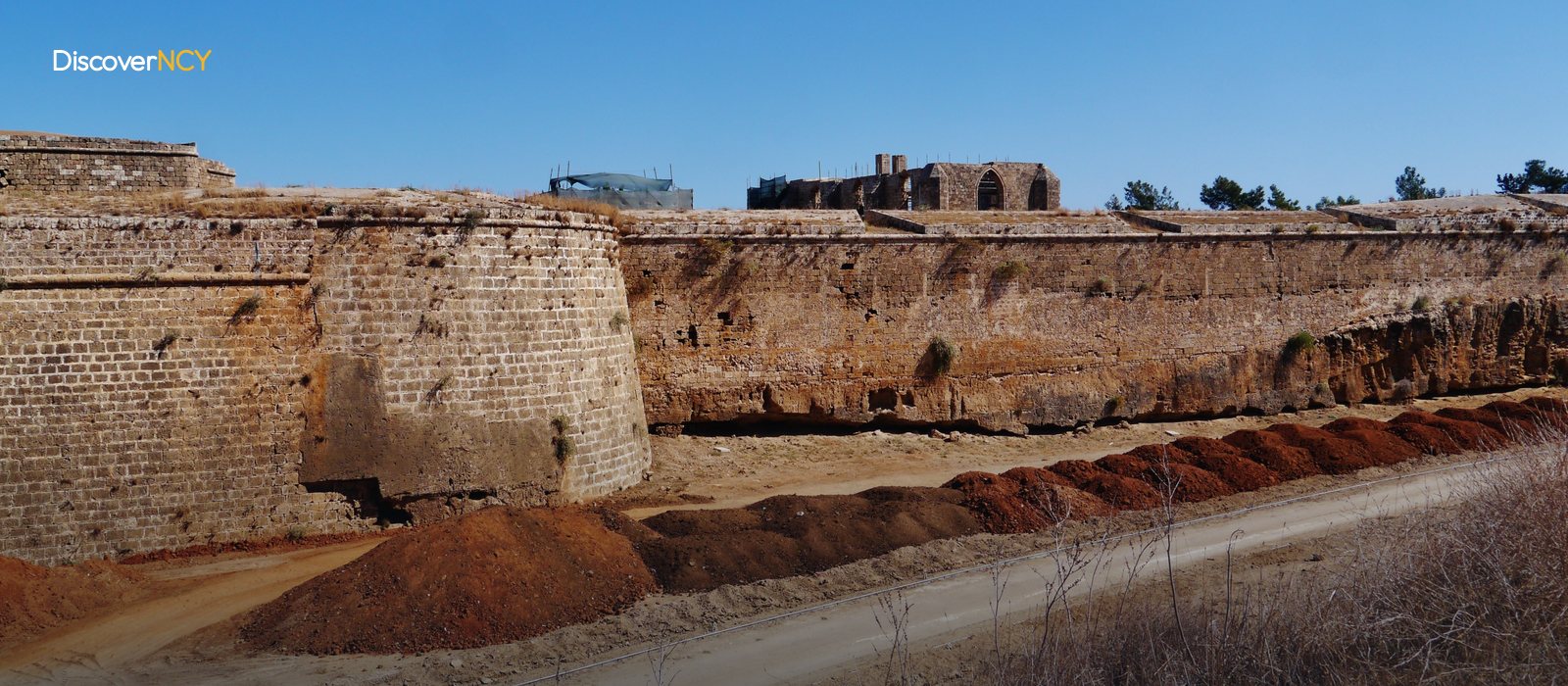
Although Venice took over the island in 1489, it was only seventy-eight years later, in 1567, that it could break ground on the new line of walls encircling the Walled City of Nicosia. This long delay exacts a heavy price for the Cyprus Venetian walls, because the new line was still not complete three years later, when the city fell on 9 September 1570. In Famagusta, however, the same test produced an entirely different result: the wall stayed standing while the provisions and ammunition inside ran out. The issue lies not only in the thickness of the stone but in how much of it had been built by the summer of 1570...
The tall tower could not stop the artillery
The height of the medieval tower worked against an attacker climbing up, but once gunpowder cannon came to dominate the field, the same height turned the defence into an exposed target. The era of the tower ended there. The solution was sought in low projections set at the corners; these masses, called burç in Cypriot sources, are also called “bastions” in technical texts.
When the bastion is lowered to a height similar to the wall between two bastions, that is, the “curtain”, the silhouette a cannonball can catch shrinks. Flanking fire opened from the corner closes off the dead zones and continues uninterrupted along the curtain. How does a wall that becomes lower and thicker become more resistant? While the earth and brick fill absorbs the impact, the sloping surface on the outer edge of the ditch, that is, the “glacis”, deflects the cannonball away from the lower body. The form was born in Italy in the mid-15th century as cannon came to dominate the battlefield; Venice brought it to the island in 1492 by rounding off the square towers of Othello Castle, and you can follow the same lowering in its later interventions.
Why were three years not enough in Nicosia?
Since the medieval line left from the Lusignan period had not been built for cannon, Venice had it demolished entirely. Behind the new line lie two basic concerns: one is artillery fire, the other the field of view that had to be cleared. The old arrangement of five gates was reduced to three. The record of five gates comes from a single source. Meanwhile, the houses, churches and monasteries outside the walls were removed both to salvage stone and to clear the ground in front, and the clearing of one thousand eight hundred houses and eighty monasteries is reported in only a single source.
Sources consider the heart-shaped bastion design better suited to the new artillery. In the summer of 1570, before it was finished, the line was besieged by the Ottoman army and, according to the sources, held out for between forty-two and forty-five days. The time was not enough. The city fell on 9 September 1570.
Famagusta’s ditch was carved into the rock
In Famagusta, the Cyprus Venetian walls did not stop at building walls; the ditch on the landward side was carved directly into the bedrock. The sources we gathered give the height of the roughly three-kilometre line as between fifteen and eighteen metres, and its thickness as between eight and nine metres. We could not find an institutional measurement. The half-moon outer work added in front of the Land Gate is called the “ravelin”.
Because the northwest corner was considered weak, Giovanni Girolamo Sanmicheli designed the Martinengo Bastion there; the document that reports this reasoning is the report of the bicommunal technical committee. Why was a ramp needed inside the bastion? The report states that the bastion was entered by a double ramp and that the ramps were intended to carry horses and heavy ammunition to the cannon inside, and it regards the bastion as “a leading example of Renaissance military architecture”. What is more, the bastion stands on the rock ground and faces the earthen floor of the ditch.
The siege of Famagusta began in September 1570 and lasted more than ten months. On 1 August 1571 Venice asked for terms of surrender, on the grounds that the provisions and ammunition had run out and the expected help had not arrived. The stone held, the provisions ran out...
In Kyrenia the slender tower gave way to a stocky one
Kyrenia Castle was also reworked in the same period as the Cyprus Venetian walls, and the Venetian intervention is seen especially in the towers: the slender Frankish towers were dismantled and replaced by stocky round towers, a change given by the single source we have. You can read the precaution against cannon in the shapes of the towers. For the completion of the work, the sources give two different years, 1540 and 1544. On the other hand, that thick wall in Kyrenia was never tested under fire, because in 1570 the castle surrendered without a fight, without seeing a siege, and only the page of one official institution records this.
Venice gave up assigning soldiers to the mountain castles of the Kyrenia Mountains (Beşparmak) earlier; the reason the sources point to is the cost of the garrisons and their loss of importance. The choice in the mountains is a budget decision. The castles remained in ruins throughout the 16th century.
Which gate is open on the 2026 summer timetable
We took access to the Cyprus Venetian walls and castles from the official visiting schedule; the summary we prepared for you is based on the summer hours from 1 April to 31 October, read on 12 October 2026. Othello Castle and the Canbulat Museum are closed due to restoration, and the Royal Tombs are simply closed. Kyrenia Castle is open 08.00-19.00 and St. Hilarion 09.00-18.30. Kantara is open on weekdays and closed at weekends and on public holidays. Akkule is also open on weekdays and closes at 15.30.
Since the schedule has no rows for Martinengo, the Sea Gate, Buffavento, the Nicosia walls or the Kyrenia Gate, we do not give hours for them. We could not obtain the winter timetable. If you are going after November, confirm the day on the official site.
When the dates we have are placed side by side, you can see that architecture alone is not enough. Kyrenia’s thick wall never took a cannonball, while Famagusta’s held out through a siege of more than ten months. Nicosia’s was not ready in time.
| Structure | Venice’s military intervention | The 1570-71 test | 2026 access (Department of Antiquities and Museums, EEMD, summer hours, until 31 October 2026) |
|---|---|---|---|
| Nicosia walls | Lusignan line demolished, new line built after 1567 | Besieged before the line was finished, fell on 9 September 1570 | No separate row in the schedule |
| Famagusta walls | Bastions, ravelin, rock-cut ditch | Held out from September 1570 to early August 1571 | No walls row in the schedule, Akkule row weekdays 08.00-15.30, last entry 15.00, match with the Land Gate unconfirmed |
| Martinengo Bastion | Northwest corner, double ramp (technical committee document) | Not found | No separate row in the schedule |
| Othello Castle | 1492, square towers turned into round towers | Not found | Closed due to restoration |
| Kyrenia Castle | Thick round towers in place of slender towers, completed 1540 or 1544 | Surrendered without a fight in 1570, single source | 08.00-19.00, last entry 18.00 |
| St. Hilarion | Assigning a garrison abandoned, reason cost | Not found | 09.00-18.30, last entry 17.30 |
| Kantara | Fate contradictory, between 1489 and 1525 | Not found | Weekdays 10.00-15.30, last entry 14.45, closed at weekends and on holidays |
We described the rock-cut ditch and the ravelin in detail in our Famagusta walls and Land Gate article; for Othello Castle Famagusta, whose towers Venice rounded off, and for Kyrenia Castle and Shipwreck Museum, which surrendered without a fight, see our separate articles.