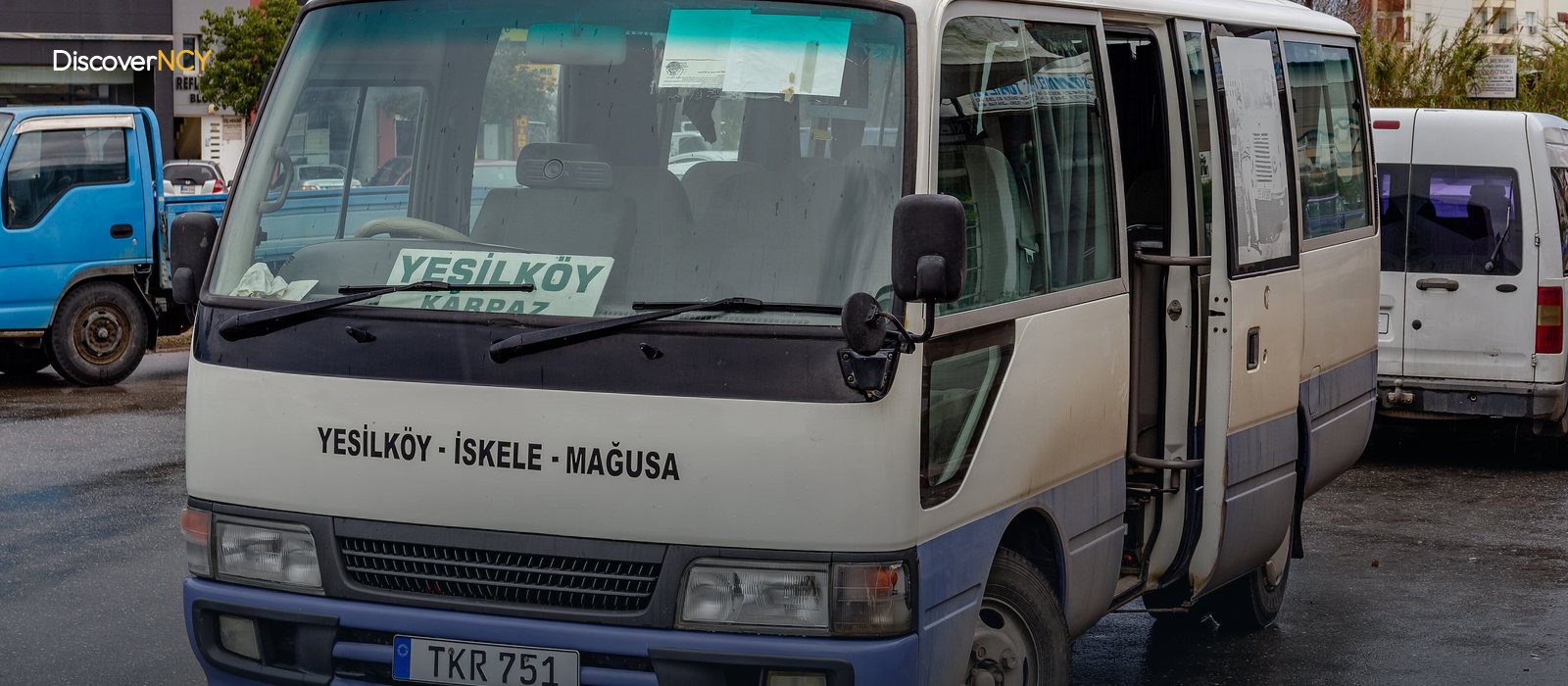
Let us give you an interesting piece of information you should know. In January 2026, the Nicosia, Kyrenia and Karpaz student shuttles did not run for thirty-two days. But Famagusta students were not left without shuttles in those days; their timetable simply thinned out. The announcement of Eastern Mediterranean University’s Transportation Services Unit dated 20 January 2026 states that these lines switched to a reduced timetable from 26 January and that more frequent shuttles returned on 16 February 2026. We could not find an up-to-date population record saying how many students live in the city today. The measure we have comes from departure times… Let us tell you the details in this guide.
Classes Are Over, What Thins Out Is the Timetable
Two documents of the institution use two different words for the same days. While no item called a “mid-term break” appears in the “EMU” (DAÜ) undergraduate calendar, the “Transportation Unit” names its own file the “mid-term break timetable” and refers to it as the “holiday period” in its announcement. Only 1 January is written as a holiday in the undergraduate calendar. That is why the reference is made to the Transportation Unit, not to the academic calendar.
While the on-campus ring shuttle runs every hour during the term, it drops to once every two hours in the break timetable. But does the campus empty out in those days too? Classes close, the campus does not. In that window, resit exams, the autumn graduation ceremony, new student orientation and course registration continue, and the undergraduate calendar does not leave these days blank.
The window itself is not fixed either. When you line up two years in the table we prepared, you can see that the first day of spring classes shifts by nineteen days. A date written without its year is misleading here...
| Item | Date | Source |
|---|---|---|
| Autumn 2026-27 classes | 21 September - 30 December 2026 | EMU undergraduate calendar |
| Autumn final exams | 4-12 January 2027 | EMU undergraduate calendar |
| Spring 2026-27 classes | 4 February - 21 May 2027 | EMU undergraduate calendar |
| First day of spring 2025-26 classes | 23 February 2026 | EMU undergraduate calendar |
| Days without classes, between the end of autumn and the start of spring (not a shuttle suspension) | 35 days (2026-27), 54 days (2025-26) | our calculation from the calendar |
| Summer term classes, 2026-27 | 28 June - 13 August 2027 | EMU undergraduate calendar |
City Lines Became More Frequent Seven Days Before Classes
The shuttles become more frequent before classes, and we see the same seven days at both returns. The unit’s announcement dated 11 September 2026 states that more frequent Famagusta and on-campus shuttles started on Monday 14 September, while the first day of autumn classes is 21 September 2026. Was the same gap there at the previous return? It was. Frequent shuttles started on 16 February 2026 and spring classes on 23 February 2026. These seven days are our own calculation; do not read them as an institutional rule.
The following note sits beneath the shuttle timetable. The sentence “if needed according to student density, shuttle times are reduced or increased and this is announced by the transportation office on its web page” is the institution’s own wording. The criterion that changes the times is student density. On the other hand, this note also explains where the seven-day difference we observed comes from.
Do Dorm Residents and City Residents Take the Same Shuttle?
Where you live also determines which shuttle a Famagusta student takes. Those staying on campus take the ring shuttle, while those living in the city use the city lines listed by the institution. That is where the difference becomes concrete. On weekdays Line 1 departs six times from Famagusta and five times from EMU, while the on-campus ring drops to four departures.
“I know what it is like to look at the EMU departure table in a morning daze one term and stand rooted like a tree at the city stop for twenty minutes for nothing,” some say. When checking the times, never forget to check the direction table, because in the timetable the Famagusta and EMU departures stand like two separate worlds.
Describing itself as a “city-campus”, the university says in its April 2026 promotional brochure that sixty per cent of its students live in different parts of the city. This ratio rests on a single document; its measurement method and date are not given there. Moreover, two institutional documents do not match. The transport page lists five city lines while the brochure mentions seven routes, and the same inconsistency continues on the dormitory side: the brochure counts three types of dormitory, while the menu of the dormitories website stays at two categories.
Did You Say Student Numbers? According to Which Document?
If one late afternoon you looked at the crowd on Salamis Road and wondered, “Come on, exactly how many of us are at this school?”, you would face three different official answers. If you open the TRNC Statistical Institute’s January 2026 yearbook, you will see the figure of 15,729 for the 2024-2025 period. If you look for something fresher, the number rises to 15,890 in the Vice-Rector’s new-term statement of 14 September 2026. The April 2026 brochure, meanwhile, takes no risks at all and simply rounds it off as “over 16 thousand”. So which one should we believe? In fact, all three are correct in their own way. These are records kept on different dates, using different methods. Rather than getting stuck on a single figure, reading all three side by side gives a much more honest range for understanding the real size of the campus.
The truly tragicomic picture begins when you look for the city’s own population. There is a detail in a footnote of the Statistical Yearbook that makes you smile. The last official population and housing census in the country was held on 4 December 2011! In other words, children born that day are now sweating at high school desks, yet the only official baseline we have is still the table from that day. That being the case, the current city population estimates flying around do not match each other at all. If you set out to divide today’s student numbers by Famagusta’s 2011 population, you will commit a mathematical massacre worse than dividing apples by pears. There is only one record in this city whose clock never goes wrong and whose feet are on the ground, and that is our trusty old shuttle timetable.
2026 Dates Are Not Every Year’s Dates
The break records belong to January and February 2026. Since we could not find the 2027 break timetable, we cannot say from here that the same pattern will repeat. The January 2025 announcements we scanned carry the same heading; we did not open their body text. Take the times for the term you will be studying from the Transportation Unit’s announcements page.
For a Famagusta student, what divides the year is the change in the shuttle timetable as much as exam week. Passengers of the ring shuttle and of the city line feel this at different times. The only thing we will tell you directly is this: do not trust a departure time you are going to use without writing next to it which year’s announcement it came from...
We covered the walled city and the coast in our Famagusta travel guide; for buses and shared minibuses beyond the shuttles see public transport in North Cyprus, and for getting into town from the airport getting from Ercan Airport to Famagusta.