In North Cyprus you could pay three very different bills for the same evening meal. The corner döner shop, the neighbourhood eatery, and a fish restaurant at Kyrenia harbour: all three say "restaurant" on the sign, but the bill multiplies as you move from one to the next. Cyprus restaurant prices have climbed fast over the past year; food inflation is running at around 50-60 percent annually, so the figure you saw last summer no longer applies this summer. The numbers below were compiled from menus in effect in August 2026. Since menus change at short intervals, read the figures as ceilings and floors rather than exact prices. Let's go segment by segment: from fast food to a meze table, from coffee to rakı — know upfront what you'll pay per person.
From Street Döner to the Neighbourhood Eatery
If you don't want to walk around hungry, street food is where you'll spend the least. The maximum prices set by the universities themselves for a takeaway döner or a kiosk toastie are actually a good indicator: in the 2025-26 term the ceiling is 300 TL, while the same item was 200 TL the term before. That's a 50 percent rise in one year — and this is a price the university caps deliberately. If you want to sit down, you move into the cafe and family-eatery segment, where the bill climbs to the 300-500 TL band. Cooked dishes like soup and grills belong to this group. Coffee is its own line item: 75 TL on average, dropping to 40 TL around campuses and reaching 100 TL in a touristy cafe. Milk-based coffees sit higher — a cappuccino-style cup can run 126-135 TL. The same cup can swing this much between two neighbourhoods; where you drink it affects the price more than the coffee does.
A Main Course at a Sit-Down Restaurant
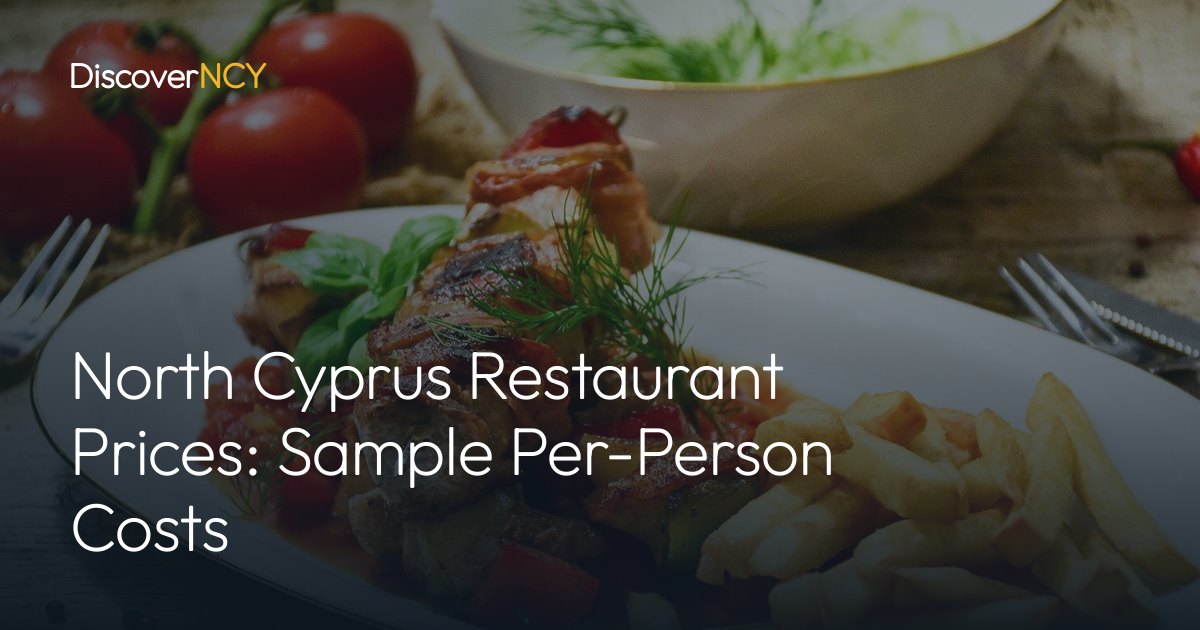
The moment you sit down and start talking to a waiter, the band shifts upward. A main course plus a drink settles at roughly 20 euros per person, that is 1,000-1,100 TL. A look at Niazi's takeaway menu in Kyrenia makes the numbers concrete: şeftali kebab boxed at 650-900 TL, rice, salad and yoghurt included; the brand's signature Full Kebab goes up to 1,150 TL. Restaurant döner is a separate item here, at 520-770 TL. Don't confuse it with street döner — same dish, two different bills. On the same menu, mantı is listed at 600 TL, tomato soup at 300 TL, lahmacun at 230 TL and cacık at 100 TL. There's a two- to three-fold gap between starters and mains. A table that opens with a 300 TL soup and moves on to the 1,150 TL Full Kebab shows you exactly which line inflates the bill.
There's a comparison point in Turkey too: the Ankara Chamber of Commerce's 2026 tariff gives a 625-2,390 TL band for kebabs and grills. Niazi's şeftali kebab lands in the upper middle of that band — so the island price stays below Ankara's official ceiling but well above its floor.
The Per-Person Bill at a Meze Table
Sit down to a meze spread and the bill doubles or triples. As of June 2026, a full fixed menu runs 1,700-2,800 TL per person. At the lower end are alcohol-free menus; at the top, premium tables with live music. For a table of four, a meze night alone becomes the heaviest item of the evening — and at the lower end, drinks aren't included. The gap between venues is stark: Elalem works at 1,500-2,000 TL, Bildiğin at 1,700-2,100 TL, Ülfet at 2,300-2,600 TL per person; at Efkâr the bill for two can reach 3,800-4,500 TL. Add rakı and the gap widens further — a standard fixed menu with rakı starts from the 2,000-2,700 TL band anyway. Is a reservation essential? Not mandatory, but it's strongly recommended for weekends at the popular spots in particular — the risk of being left without a table is real.
Fish at Kyrenia Harbour
At Kyrenia harbour, the bill is written not by the menu but by the needle on the scale. Guides written for British expats put a starter for two, two mains and local drinks at 30-50 pounds, which comes to roughly 1,000-1,700 TL per person. Niazi's menu has concrete figures: grilled sea bream 900 TL, sea bass 950 TL, fish skewer 850 TL. Here's why prices vary so much: in most places fish is sold by weight, and the figure on the menu may be the price per kilogram, not per portion. Before ordering, ask the waiter how many grams the fish weighs and what the total on the bill will be — the uncertainty ends right there. Complaints about double pricing for tourists are a recurring theme in Google reviews; the solution is that simple.
The True Cost of Drinks
When it comes to drinks, the direction reverses: here Cyprus restaurant prices sit well below Turkey's. In supermarkets, alcohol prices in North Cyprus look like this: local beer sells for 40-65 TL and a 70cl bottle of rakı for around 480-680 TL. Two bottles side by side on the shelf sum up the difference: local Efes Extra at 55.50 TL, imported Corona at 72 TL. Considering you'd pay 90-110 TL for the same bottle in Turkey, you'll feel the island's tax difference in your pocket on the very first evening. In restaurants and bars, prices rise 2-3 times over the supermarket; in practice a local beer at the table lands in the 100-165 TL band. A soft drink is 95 TL on Niazi's menu. With wine, it's hard to quote a table price upfront; the gulf between a cheap local bottle and an imported label runs from about 90 TL to 750 TL in the supermarket, and it doesn't close in restaurants. If you've chosen a fixed menu with rakı, the rakı is included in the bill — no need to order it separately at the table.
The Same Plate, Different Neighbourhoods
Location changes the bill too. Kyrenia's tourist strip and the harbour area are the most expensive; a neighbourhood eatery serving the same dish usually comes in cheaper. Nicosia sits in the middle, while Famagusta, thanks to its large student population, is the most affordable city. Is there a precise percentage? No, but put the price lists side by side and the difference jumps out: the same grill plate at the harbour costs considerably more than at the neighbourhood eatery.
When the Bill Arrives: Card, Cash, Tips
Paying by card in Cyprus works at almost every sit-down restaurant; the places where you can't pay by card are kiosks and market stalls, where cash may be the only option. Tipping runs in the 5-10 percent band and isn't obligatory, but even if you pay by card, the tip is left on the table in cash. If a service charge has been added to the bill, no additional tip is expected on top. In Turkey, making the service charge compulsory has been banned; in the TRNC (North Cyprus) there's no rule governing this, so whether service is added to the bill is left to the establishment's discretion.
With Cyprus restaurant prices, the same evening can fill you up for 300 TL or for 2,500 TL. The distance between the two is opened largely by the table you sit at: the neighbourhood, the type of venue, and whether drinks arrive at the table. On a week-long holiday, it's perfectly possible to devote two evenings to a meze table and the rest to neighbourhood eateries; split the Cyprus holiday budget that way from the start and the bill won't surprise you.