Lapta’s name appears in the credentials of two separate crafts. One is Lapta work, which advances with a needle on linen, the other pottery, which deals with clay, and both are referred to under the heading of Cyprus handicrafts... We can say that the two crafts went in different directions. While embroidery found a place in course programmes and on the cooperative’s shelf in 2021, on the pottery side it was recorded in 2025 that the only workshop keeping the tradition alive was about to close. The story of Lefkara work is similar: the place where the name was born and the geography where the technique lives have drifted apart over time...
Cutting and Drawing on Linen
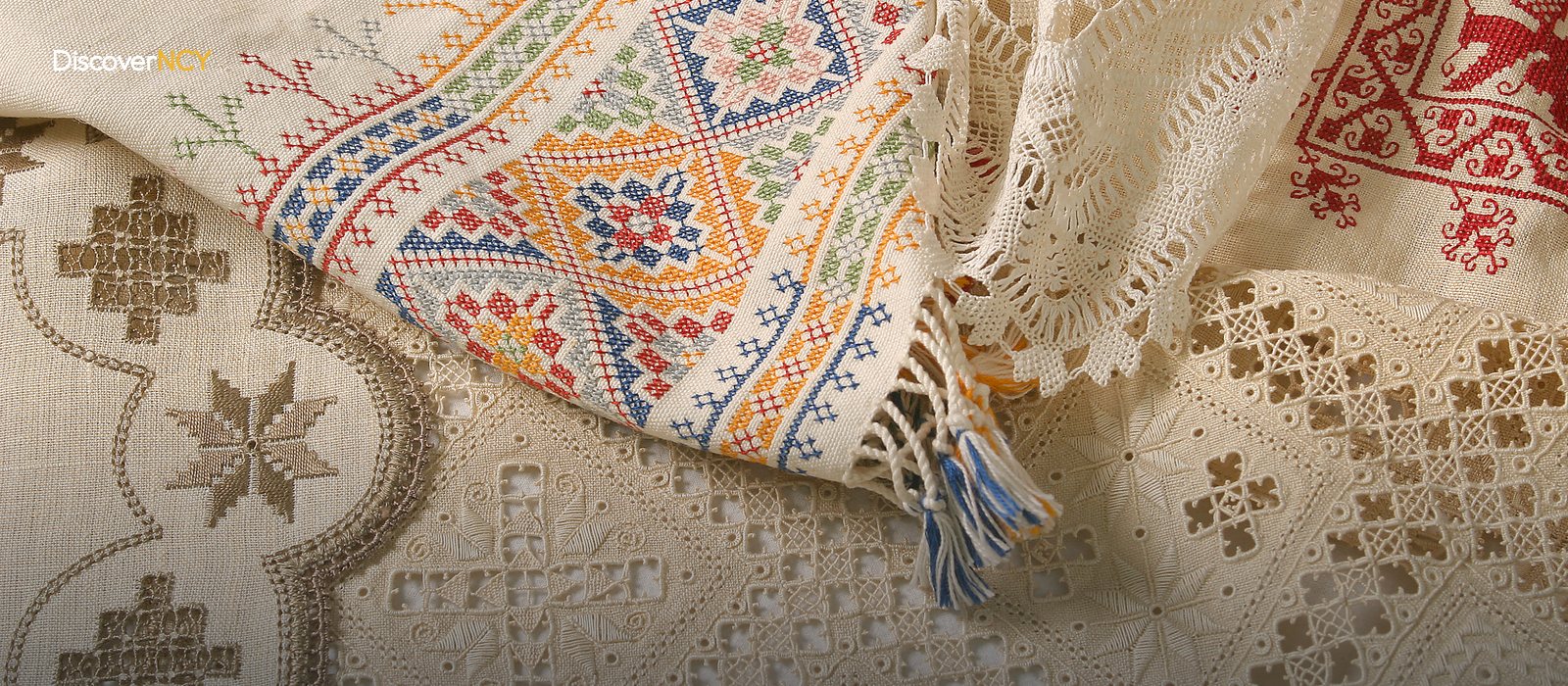
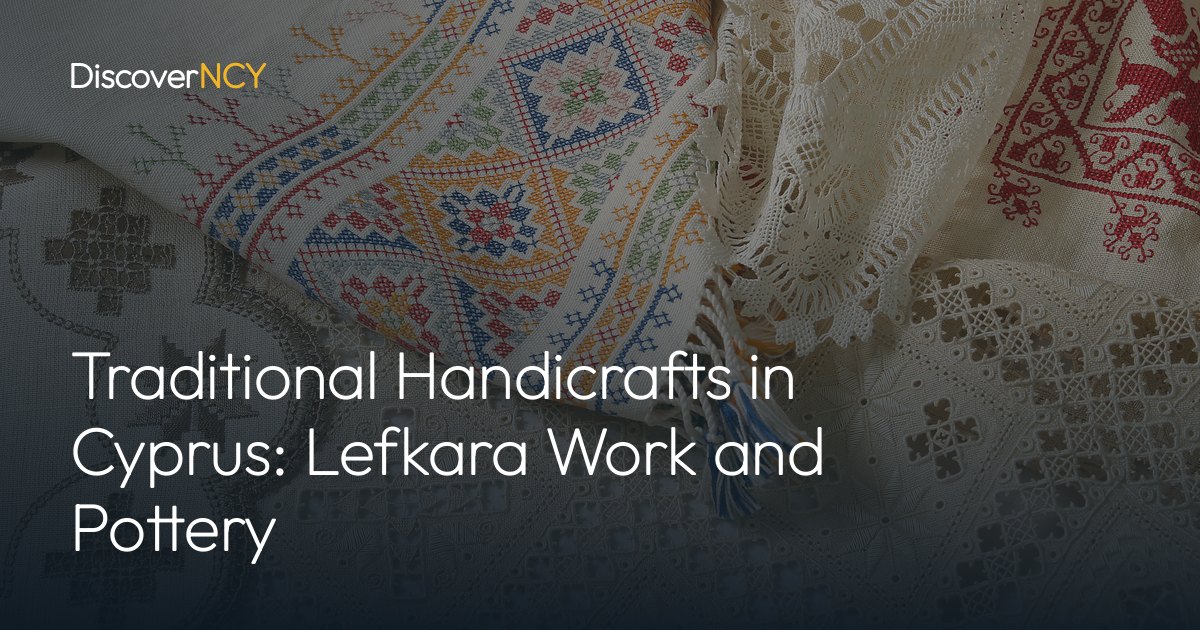
While “Lefkara” work takes its name from a village in the south of the island, in the north it is also taught and worked under its own name. Once the warp and weft threads of the linen fabric are cut and drawn in a calculated number, the emptied weave is filled with susma and sarma stitches. In 2009 “UNESCO” added the “Lefkara laces or Lefkaritika” file to the Representative List of the Intangible Cultural Heritage of Humanity, but this inscription was opened on behalf of the State Party “Cyprus” and describes the village practice in the south. In the covers worked in the north, you can see the trace of cut-and-drawn openwork up close.
But would it be right to call this embroidery lace outright? The 2021 field study we examined as a team distinguishes between lace and embroidery within “Cyprus handicrafts” and stresses that the work widely done in the north is openwork embroidery. Needle lace, on the other hand, appears in the same study as a craft that has “declined considerably because it is laborious”. The two techniques are built differently...
How Many Threads Are Cut in Openwork
The name of the openwork is determined by the number of threads cut from the fabric. When four threads are cut and four left in the weave, the work is called dere kesme or fincan kesme; in mekik kesme two threads are cut and four left, while in jasmine (yasemin) openwork the count proceeds by cutting eight and leaving four. The pattern depends on the number. Motif names such as arşın işi, elma (apple), baklava, güneş (sun) and tripes are also built on this geometric construction. On the pieces at the stall, you can easily tell the type of openwork apart by looking at the thread counts.
We also saw it written in the 2021 field study that no single person sits at the same cover. While one of the women cuts and draws the thread, another sets up the openwork, someone else carries out the susma and sarma, and the last craftswoman takes on the edge finishing. The craftswomen recognise the right side from the back. Not all of the materials used are local, however; let us note that the raw linen is imported from Ireland and the mercerised cotton thread from a French brand.
How Are Threads Counted in Lapta?
The embroidery associated with Lapta, west of Kyrenia, and known in the sources as “hesap işi” (counted work) also relies on thread counting. In this tradition, which among Cyprus handicrafts takes its name from its locality, the work proceeds on linen by counting two or three threads, using plus, cross and gözeme stitches. The colours gather in blue-green tones, tomato red, black and brown, while looking at motif names such as bardacıklar, tarak (comb), kutulu çiçek (boxed flower), cevizli (with walnuts), kuşlu (with birds) or ejderha (dragon), you can sense what is depicted on the fabric. The term “hesap işi” refers not to Lefkara work but directly to Lapta work.
When did this embroidery begin? The academic source we reviewed says on the one hand that the tradition goes back to the 19th century, while in the same paragraph it reports that it spread when a primary school teacher taught it to girls and women in Lapta in the 1930s. The starting year is uncertain. Since the gap between the two accounts does not close, coming down to a single date does not seem possible with the record we have.
The Latest Course Information Dates from December 2024
On the production and training side, two civil institutions stand out. It is written in the 2021 record that the “Turkish Cypriot Handicrafts Cooperative” (Kıbrıs Türk El Sanatları Kooperatifi), founded in 1962, is run by women, provides income to rural producers and sells its products at the Büyük Han in Nicosia... The “HASDER Handicrafts Centre”, whose origins are implied to go back to the Folk Arts Institute of 1977, has been operating next to the Selimiye Mosque since 2000. What is more, the centre’s course list includes, besides lace and embroidery, traditional hand weaving, sele and sesta woven from barley and wheat straw, and silk cocoon panels.
The only concrete recent training record is an embroidery workshop that a university and an association ran with ten students on 21-28 December 2024. After that, silence. Meanwhile, although a 2011 news report mentions that such training was also given at the culture house in Büyükkonuk, as of October 2026 we could not find an open course; you can find out the current schedule by asking these two institutions directly...
The Clay Side of the Same Name
Among Cyprus handicrafts, the weakest record we have is in pottery. A single 2025 academic study writes that Lapta was an important ceramics centre in the past and that the only workshop continuing traditional production is “at the point of closing”, basing its data on an interview with the workshop owner. It has not been researched before. Nevertheless, we could not find any record of the source of the clay, the forms produced or the status of the workshop in 2026.
Pottery is not the only vanishing trade. In the list of 20th-century Nicosia crafts, the note “have passed into history” is also made for mat weaving. In the table we have prepared for you, you can find together what each craft is based on and its latest date in the sources. Before marking Lapta as a pottery stop, we recommend confirming that the workshop is open in 2026, because while the traces in embroidery extend to December 2024, on the pottery side they seem squeezed into a single interview.
| Craft | What the name is based on | Technique and material | Date and status in the source |
|---|---|---|---|
| Lefkara work | A village name | Cut-and-drawn openwork on linen, susma, sarma | UNESCO inscription 2009, on behalf of Cyprus. Its working in the north was written in 2021 |
| Needle lace | The technique itself | Lace made with a needle | “Declined considerably”, 2021 |
| Lapta work (hesap işi) | The Lapta area | Counted thread, plus, cross, gözeme stitch | Two accounts, 19th century and 1930s, current record Not found |
| Cocoon work (koza işi) | The material, silk cocoon | Cocoon flowers, panels, bridal crowns on velvet or satin | Sericulture continued until 1955, revival claim single source |
| Sele and sesta | The material, barley and wheat straw and reed | Coiled weaving, köfün, zembil, oil zembil | Written in 2001 to be widespread in the villages of Serdarlı and Yayla |
| Hand weaving | The material, cotton, wool, silk | Plain cloth weaving, kilim | Kilim in villages around Famagusta, undated source. Weaving course 2021 |
| Pottery | The craft itself, production site Lapta | Clay source and forms Not found | Single workshop “at the point of closing”, 2025, single source |
We covered Lapta and its surroundings in our Alsancak and Lapta travel guide; see also our Büyük Han Nicosia article, where the cooperative sells, and our what to buy in Cyprus guide for handmade souvenirs.