The cathedral in the city was standing in place on 9 September 1570, the day Nicosia changed hands, and the first Friday prayer was performed under the same roof on 15 September. The question for Cyprus Gothic architecture arises from here: when a cathedral is converted into a mosque, which element stays in place and which is erased? Placing these two dates side by side leaves six days between them. In Famagusta, the dates are a year later. The cathedral there was taken in August 1571 and today has stood closed since April 2026.
Bell Towers Never Finished and Two Minarets Added
The foundation stone of the building in Nicosia is cited as 1209, and the consecration was carried out in 1326 by Archbishop Giovanni del Conte. The difference between the two dates we have is one hundred and seventeen years. This figure is not readily given in the source. On the day it was consecrated, the building was still not finished. According to the record of the tourism promotion site visitncy, the bell towers were never completed. The cathedral was left unfinished. Nevertheless, two minarets rose between 1570 and 1572, and the mihrab and minbar were placed inside the building in 1570.
We could not find a measured record of the mihrab’s position within the building or of the qibla angle. On the other hand, the 1874 intervention appears in the same way in two sources: a Lusignan window at the eastern end was enlarged and opened to the outside under the name “Aziziye Gate”. The window became a door. According to the restoration breakdown on Wikipedia, the reinforcement approved in 2023 includes stainless steel tie rods. Selimiye reopened for worship on 8 May 2025...
The 1311 Inscription on the Buttress in Famagusta
The same interval is much narrower in Famagusta. Construction began in 1298, and while the building stood up around 1312, its consecration came in 1328. Within Cyprus Gothic architecture this building is associated with the radiant Gothic, or “Rayonnant”, style; according to Wikipedia, this form is rare outside the borders of France. The date, meanwhile, is read from the stone. According to the same record, the 1311 inscription on the southern buttress was published by Camille Enlart in the 19th century.
The stone outside stayed in place. The interior was rearranged from scratch after 1571. According to the building record on Wikipedia, after the conquest the statues, crosses, stained glass, frescoes and paintings of the interior were almost entirely either removed or left beneath a layer of plaster, and the altar and most of the tombs were removed in the same period. A few tombs in the north nave can still be made out. When the upper parts of the towers were damaged in earthquakes and in the 1571 bombardment, they were never repaired again; today the façade, with its three doorways and the two towers beside the nave, stands under a flat roof. The “Bembo Loggia”, added to the southwest corner after 1480, adds the Venetian layer to the same façade...
In Which Year Did the Two Hagia Sophias Take Separate Names?
Why is it so hard to tell the two Hagia Sophias apart? Because both buildings of Cyprus Gothic architecture are recorded as “Hagia Sophia” (Ayasofya) until 1954. The name “Selimiye” was given to the mosque in Nicosia by the Mufti on 13 August 1954, in memory of Sultan Selim II. The building in Famagusta took the name “Lala Mustafa Pasha” in the same year; we see this in a single source. Same year, different city. If you ask about the city when asking about the name, you can avoid the confusion. Thus, after being carried in two cities at once for about three hundred and eighty years, the name “Hagia Sophia” split into two separate names in 1954; we calculated this period ourselves from the two dates we have...
The Gothic Abbey That Was Not Converted into a Mosque
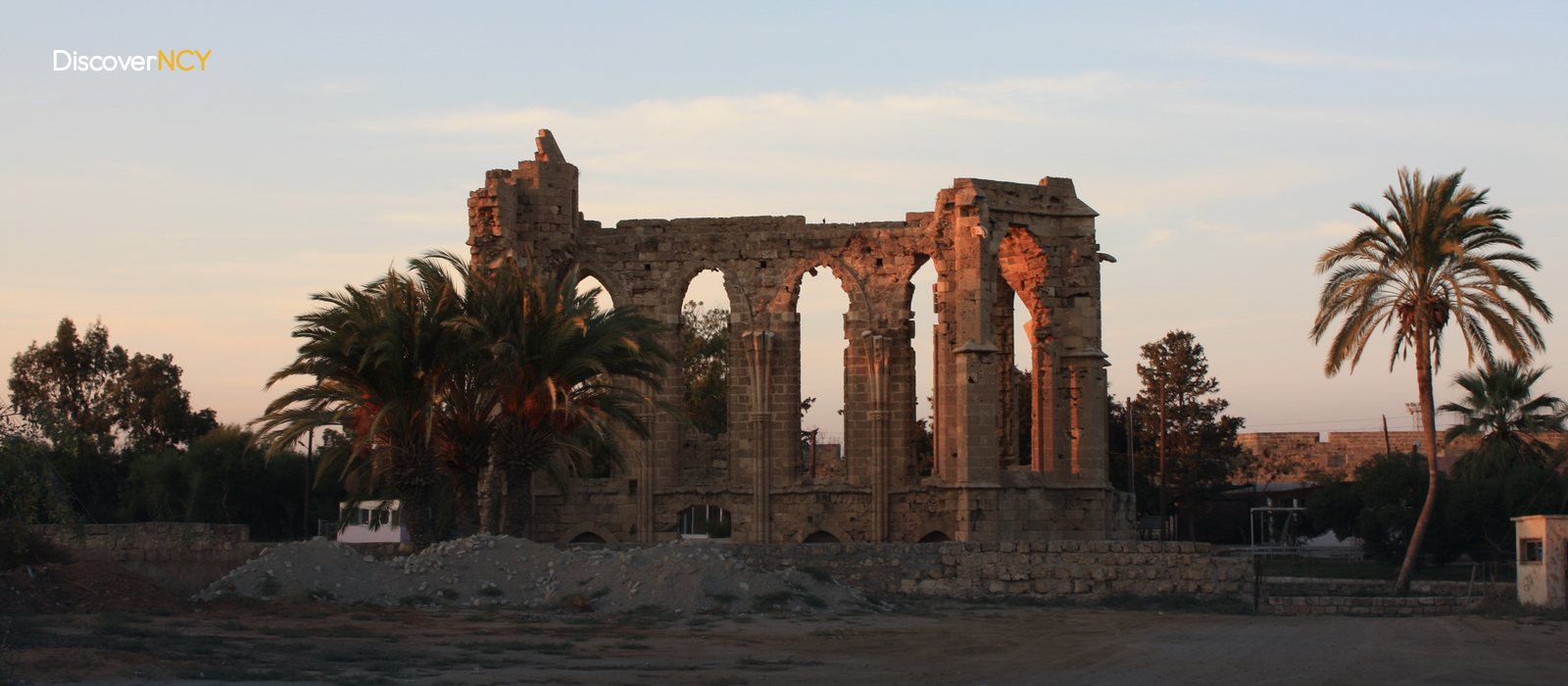
If you think all Gothic buildings were converted into mosques, you may be surprised in Bellapais (Beylerbeyi). Bellapais Abbey was not converted into a mosque after 1571; while the Catholic community was removed from the building, ownership passed to the Church of Cyprus (Orthodox). While the two Latin cathedrals in the city became mosques, the Latin abbey in the village was used as an Orthodox church. We could not read the reason in the sources. Today the building operates as a site under the Department of Antiquities and Museums (Eski Eserler ve Müzeler Dairesi) and is open during summer hours.
The Mosque Closed Since April 2026
Lala Mustafa Pasha Mosque has been closed to worship and visits since April 2026. We could not find an announcement of an end date. The period given by an official is three to four years. In the official visiting schedule, the Royal Tombs, the Canbulat Museum and Othello Castle also appear closed, and these three items affect the Famagusta side. Selimiye and Lala Mustafa Pasha do not appear in the schedule. You can follow the current status in the announcements of Evkaf (the Pious Foundations Administration) and the Religious Affairs Department. Bellapais, on the other hand, appears open in the same schedule; the summer timetable ends on 31 October 2026.
The order is set as much by opening hours as by Cyprus Gothic architecture. Selimiye is still an active mosque. No fixed visiting hours are announced. Avoiding the five daily prayer times is, according to the record of the same promotion site, your responsibility. Leave your shoes at the entrance, dress modestly and stay quiet inside. In the order we have prepared for you, we recommend putting Nicosia early in the day and taking the reality of closed doors on the Famagusta side into account from the outset. These three buildings together also show the measure of conversion: in Nicosia a window was turned into a door, in Famagusta the stained glass ended up under plaster, and in Bellapais only ownership changed hands.
| Building | Gothic construction | Conversion | Status in 2026 |
|---|---|---|---|
| Selimiye Mosque (former Hagia Sophia), Nicosia | Foundation stone cited as 1209, consecration 1326, three west doorways on the façade (Wikipedia) | Mihrab and minbar 1570, minarets 1570-1572 | Active mosque, no closure record |
| Lala Mustafa Pasha Mosque (former St. Nicholas), Famagusta | 1298-1312, consecration 1328, Rayonnant | Mosque after August 1571 | Closed since April 2026, three to four years |
| Sinan Pasha Mosque (former Saints Peter and Paul), Famagusta | 14th century | Mosque after 1571 | Accessible status, we could not find a record of hours |
| Bellapais Abbey, Kyrenia | First buildings 1198-1205, church 13th century, 18-arched cloister 1324-1359 | Handed over to the Orthodox Church, never became a mosque | Site open on the summer timetable |
| St. George of the Latins, Famagusta | Late 13th, early 14th century | Not converted, its south side and vaults collapsed during the siege | Ruin, no item in the schedule |
We covered the visiting details of these three buildings separately in our Selimiye Mosque Nicosia, Lala Mustafa Pasha Mosque Famagusta and Bellapais Abbey Kyrenia articles.