Karaman (Karmi) Village: Mountain Village Guide
📍 Karaman (Karmi), Kyrenia
Karaman village... In the late 1970s an unusual proposal came before the Council of Ministers. Eight kilometres west of Kyrenia, on a mountainside, there was a village left completely empty, and this village was to be restored, but the cost of the restoration would be borne not by the state but by foreigners who would lease the houses on long terms. The decision duly followed. The stone houses got back on their feet, and Karmi village owes its present-day fabric to that programme. In exactly which year did the programme start? If you ask, the records we researched online give different dates between 1979 and 1986, and for the lease term you will find 49 years in some places and 25 in others, so it is not possible to pin the programme's timeline to a single year, nor to establish for certain which ministry ran it. The date is disputed, but the result the decision left on the streets is plain to see… Let's go through the details.
A Single-Lane Road Climbing the Hillside
Heading west on the coast road, you turn at the "Karaman" sign, and from there the road climbs straight up the mountain. The sign says "Karaman", but on the map and in everyday speech you will hear "Karmi", so our advice is to keep both names in mind... After a few hundred metres the road narrows. As the asphalt drops to a single lane and climbs through sharp bends, the gradient never lets up at this point, and since traffic in Cyprus flows on the left, you need to stay in the left lane throughout the climb and hug the inside of every sharp bend. An ordinary car gets up here comfortably; don't go looking for a 4x4.
The climb ends at the square. This is roughly three hundred metres above sea level, and the whole coastline opens up below. Parking is in the square. The rest is done on foot; the distance is short, but the slope makes itself felt straight away.
Who Restored the Empty Houses
For almost all of its history, Karmi was a Greek Cypriot village. The population was 518 in 1901 and 528 in 1973, so in seventy years it hardly changed at all. After 20 July 1974 the villagers dispersed to the south of the island and the houses stood empty. The following year there was an attempt to resettle the village, but since the migrants arriving from the South did not want to stay on this high, isolated hillside, the village soon fell silent again, and the stone houses on the slope were left ownerless for a second time.
The answer came from outside the village. The programme approved by the Council of Ministers tied the job to the house itself: the foreigner taking on the restoration would pay for it out of their own pocket, would work with local architects and craftsmen using traditional building techniques, and in return could lease the house for many years. Today roughly a hundred and fifty houses have been brought back to life this way. Our note is this: the condition shaped not only the walls but the whole look of the street. Wooden beams and reed ceilings repeat in the same pattern, and above every courtyard gate hangs a small plaque bearing the name of the house. The street names come from the surrounding trees and flowers, something you will notice at the first bend...
Karmi's quiet present-day profile is a product of the same programme. How many people live in the village today? The number of permanent residents does not exceed a few dozen, most of them long-term European tenants, predominantly British. The village's nickname of "the English village" comes from this profile. In the holiday season the number multiplies several times over.
The Church on the Square Is Now a Museum
A tour of the village begins at the small square where the car park is; the Orthodox building on the edge of the square is the Church of the Virgin Mary, built before the Greek residents left. The church has been restored, and its interior is now used as a small icon museum. On top of that, on certain days of the year the building turns into a concert venue; at Christmas the European residents' carol concert is held here.
Because the streets leading off the square follow the hillside, the view changes at every bend. On one side you can see the coastline and the Mediterranean, on the other the mountain range and St. Hilarion Castle. What caught our eye was the castle's position: it stands almost directly above the village, so anyone looking up from the village picks it out without searching.
You Can Count the Shops on One Hand
Don't think of it as a busy place. Eating and drinking in the village is limited to a few doors. A grocer's and a pub are the fixtures, and a few small bistros open in the evenings. One of them is The Levant restaurant, close to the village centre. Bear in mind that in small village businesses the name and ownership can change from time to time, so confirm your table for dinner by phone. There is no hotel or boutique accommodation in Karmi village known by its own name; a bed for the night is sorted out on the Kyrenia side.
No Getting Here Without a Car, Half a Day Is Enough
Reaching Karmi village by public transport is in practice impossible, so bear this in mind and hire a car if necessary. Since the bus route does not climb the hillside, the trip can only be made in a rental car or a taxi hired from Kyrenia; unfortunately there is no other option. The journey from central Kyrenia to the square takes between fifteen and twenty minutes, which fits comfortably into a half-day outing.
In which season does the village look its best? Spring, from late February to May, is when the bougainvillea and seasonal flowers cover the stone walls. The flowers are still there in July and August, but climbing the slope in the midday heat is nobody's idea of fun. In January the village goes very quiet, and the wind never leaves the hillside.
The visit itself doesn't take long. An hour or two is enough to wander the streets; with a meal and photos, half a day is the most comfortable measure. A note for you: if you are willing to stretch that half day a little, Bellapais can be added to the same outing, because the two villages are lined up on the same foot of the Kyrenia Mountains, on the hillside directly above Kyrenia. Visiting the village is free, there is no ticket booth at the gate, and the whole cost comes down to the road and dinner.
| Field | Value |
|---|---|
| Name | Karmi (Karaman), mountain village in Kyrenia district |
| Location | North slope of the Kyrenia Mountains (Beşparmak), west-southwest of Kyrenia |
| Distance to Kyrenia | About 8 km, 15-20 minutes by car |
| Altitude | 300-350 m band (sources differ) |
| Road | Narrow, single-lane mountain road with sharp bends, keep to the left |
| Pre-1974 population | 518 in 1901, 528 in 1973 |
| Population today | Varies by source, a few dozen permanent residents, multiplies in season |
| Restoration programme | Council of Ministers decision from the late 1970s, long-term leases (25-49 years depending on source) |
| Restored houses | About 150-155 |
| Resident profile | Mostly European, largely British long-term tenants |
| Church | Church of the Virgin Mary, icon and religious heritage museum, concert venue |
| Necropolis | Lapatsa (13 dromoi, 15 chambers) and Palealona (14 dromoi, 19 chambers), excavated 1961 |
| Necropolis period | Middle Bronze Age, 1900-1625 BC |
| Finds | Over 900 ceramic vessels, 39 metal tools and weapons, a Cretan Kamares bowl, Egyptian turquoise beads |
| Food and drink | The Levant restaurant, a grocery, a pub, a few bistros |
| Accommodation | No confirmed hotel name, a day-trip and dinner stop |
| Best season | Late February - May (flowering season), January deserted and windy |
| Visit length | 1-2 hours to walk around, half a day with a meal and photos |
| Getting there | No public transport, rental car or taxi |
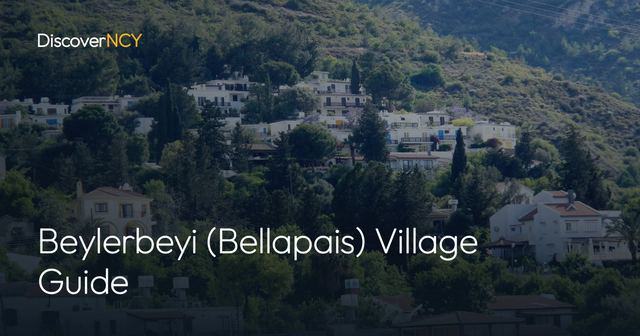
For the neighbouring village on the same hillside, see our Bellapais village guide; for the castle standing almost directly above the village, read about St. Hilarion Castle; and to sort out a car for the climb, check our Kyrenia car rental guide.